
The eBooks we sell are sold as a single-user licence and are intended for the end user only.
The sale of some eBooks are restricted to certain countries. To alert you to such restrictions, please select the country of the billing address of your credit or debit card you wish to use for payment.
For further information see https://www.wildy.com/ebook-formats
Once the order is confirmed an e-mail will be sent to you to allow you to download the eBook. For UK purchases this will be automatic. For purchases outside the UK a member of staff will need to confirm the sale. (Staff are available to do this during normal business hours, Mon-Fri 8:30-17:00 UK time)
All eBooks are supplied firm sale and cannot be returned. If you believe there is a fault with your eBook then contact us on ebooks@wildy.com and we will help in resolving the issue. This does not affect your statutory rights.
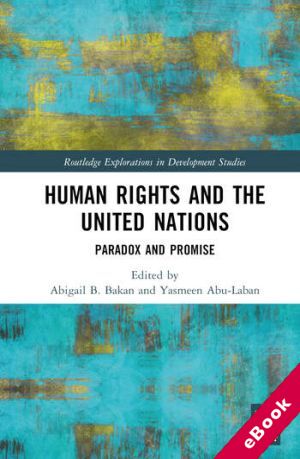
This book considers the complex and contradictory role of the United Nations when it comes to human rights around the world. It depicts the United Nations as a global arena in which state and non-state actors continuously contest issues around human rights. This ongoing contestation simultaneously produces both advances and setbacks when it comes to the rights of stateless populations, women, Indigenous Peoples, racialized people, as well as rights related to health and the environment.
Since the 1948 Universal Declaration of Human Rights and throughout various subsequent expansions, conventions and declarations, the United Nations has been central to the development and advancement of human rights as a primary, stated goal of global governance. However, there are various inherent contradictory tensions and challenges embedded in United Nations promise for human rights. This timely collection investigates the United Nations’ role as knowledge producer, its relation to non-state actors, and the United Nations’ role as a system for grouping sovereign states, where there is uneven buy-in within non-binding agreements and tensions between national sovereignty and human rights. At a time when the world faces existential challenges from climate change to pandemics, which disproportionately impact the world’s most vulnerable populations, this book addresses future challenges and possibilities for the United Nations.
Human Rights and the United Nations: Paradox and Promise will be an important read for researchers and students across the fields of human rights, political science, international relations and global development, as well as for United Nations and governmental policy analysts and advisors.










