
The eBooks we sell are sold as a single-user licence and are intended for the end user only.
The sale of some eBooks are restricted to certain countries. To alert you to such restrictions, please select the country of the billing address of your credit or debit card you wish to use for payment.
For further information see https://www.wildy.com/ebook-formats
Once the order is confirmed an e-mail will be sent to you to allow you to download the eBook. For UK purchases this will be automatic. For purchases outside the UK a member of staff will need to confirm the sale. (Staff are available to do this during normal business hours, Mon-Fri 8:30-17:00 UK time)
All eBooks are supplied firm sale and cannot be returned. If you believe there is a fault with your eBook then contact us on ebooks@wildy.com and we will help in resolving the issue. This does not affect your statutory rights.
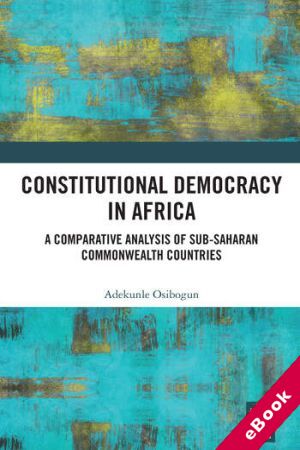
This book examines the development of constitutional democracy in Commonwealth Sub-Saharan African countries. It focuses specifically on the constitutional systems of different countries and their effectiveness in curbing excesses in the exercise of government powers and functions. The work highlights a culture of subordination prevalent in the governance structure inherited from the colonial era in Sub-Saharan Africa and identifies weaknesses in the ability of existing constitutional institutions to properly implement the doctrine of separation of powers and systems of checks and balances.
The work is divided into three parts. Part I considers the theoretical concept of constitutional democracy and its relevant institutions, while also examining the role of separation of powers in constitutional democracy and the different constitutional systems in Commonwealth Sub-Saharan Africa. Part II focuses on the development of constitutionalism in Commonwealth Sub-Saharan Africa, using certain Commonwealth countries as case studies, and examines the institutional operating framework and features of the organs of government within their constitutional democratic systems. Part III compares the constitutional restraints on government practices existing in the constitutional democratic systems of some Commonwealth Sub-Saharan African countries, and makes a series of detailed recommendations designed to strengthen the operation of separation of powers and systems of checks and balances in constitutional systems in Sub-Saharan Africa.
The book will be of interest to academics, researchers and policy-makers working in the area of comparative constitutional law and politics, African history and African studies.










