
The eBooks we sell are sold as a single-user licence and are intended for the end user only.
The sale of some eBooks are restricted to certain countries. To alert you to such restrictions, please select the country of the billing address of your credit or debit card you wish to use for payment.
For further information see https://www.wildy.com/ebook-formats
Once the order is confirmed an e-mail will be sent to you to allow you to download the eBook. For UK purchases this will be automatic. For purchases outside the UK a member of staff will need to confirm the sale. (Staff are available to do this during normal business hours, Mon-Fri 8:30-17:00 UK time)
All eBooks are supplied firm sale and cannot be returned. If you believe there is a fault with your eBook then contact us on ebooks@wildy.com and we will help in resolving the issue. This does not affect your statutory rights.
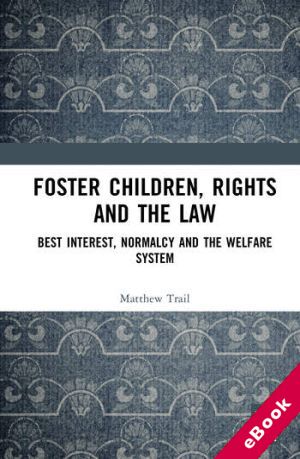
This book discusses child wishes, rights and participation in the foster care system.
Making decisions in a foster child’s best interest is a widely used, but also widely criticized international legal doctrine. This work discusses the two major legal frameworks, best interest and normalcy, for which foster care decisions are made and how those frameworks might shape how child welfare professionals view and interpret children’s rights and participation. Normalcy, the idea that decisions should promote a “normal” life, is a separate legal doctrine which can be in conflict with best interest determinations. However, the concept of normalcy is also theoretically built into best interest decisions, and therefore also plays a role in most child welfare systems. Mixing both empirical legal and child welfare research, the book demonstrates the ways in which risk aversion and fear drive best interest decision making to the detriment of both practitioners and the children they aim to serve. It argues that a children’s rights framework starting with normalcy is a better tool for promoting child participation and centering the child within the dependency process.
The book will be of interest to academics, researchers and policy-makers working in the areas of Children’s Rights Law, Child Welfare, and International Human Rights Law.










