
The eBooks we sell are sold as a single-user licence and are intended for the end user only.
The sale of some eBooks are restricted to certain countries. To alert you to such restrictions, please select the country of the billing address of your credit or debit card you wish to use for payment.
For further information see https://www.wildy.com/ebook-formats
Once the order is confirmed an e-mail will be sent to you to allow you to download the eBook. For UK purchases this will be automatic. For purchases outside the UK a member of staff will need to confirm the sale. (Staff are available to do this during normal business hours, Mon-Fri 8:30-17:00 UK time)
All eBooks are supplied firm sale and cannot be returned. If you believe there is a fault with your eBook then contact us on ebooks@wildy.com and we will help in resolving the issue. This does not affect your statutory rights.
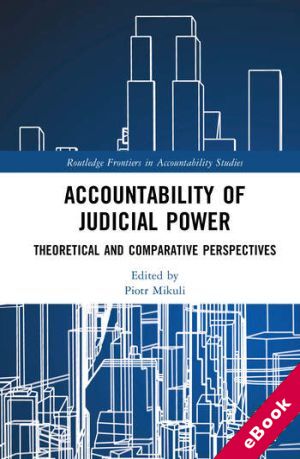
This book brings together a group of international scholars to discuss theoretical and comparative considerations of judicial accountability.
Accountability of the judiciary is an essential element in a democratic state ruled by law. Its design must take into account the need to ensure both the legitimacy of the judiciary and its independence. The work discusses accountability in the light of recent research, including studies on the crisis of the rule of law in the contemporary world. The book adopts a broad approach to accountability, which has various facets, referring both to the courts, that is the organisational element of the judicial branch of government, and to judges, its individual dimension. Divided into four parts, the first deals with the essence of the concept of accountability of the judiciary; the second discusses the emerging standards relating primarily to the individual accountability of judges, while the third discusses the position of constitutional judges through the lens of accountability. The fourth and final part provides a detailed consideration of the specific accountability mechanisms.
The book will be a valuable resource for academics, researchers and policymakers working in the areas of Constitutional Law and Politics, and Accountability Studies.










