
The eBooks we sell are sold as a single-user licence and are intended for the end user only.
The sale of some eBooks are restricted to certain countries. To alert you to such restrictions, please select the country of the billing address of your credit or debit card you wish to use for payment.
For further information see https://www.wildy.com/ebook-formats
Once the order is confirmed an e-mail will be sent to you to allow you to download the eBook. For UK purchases this will be automatic. For purchases outside the UK a member of staff will need to confirm the sale. (Staff are available to do this during normal business hours, Mon-Fri 8:30-17:00 UK time)
All eBooks are supplied firm sale and cannot be returned. If you believe there is a fault with your eBook then contact us on ebooks@wildy.com and we will help in resolving the issue. This does not affect your statutory rights.
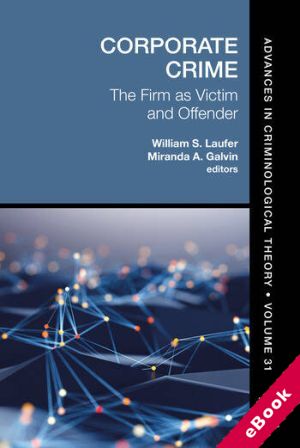
This volume speaks to the fundamental issues inherent in trying to understand the who-what-where-and-whys of corporate crime. Only in addressing these larger issues does it become possible to begin to integrate the study of corporate crime into the larger criminological theory literature. A collection of chapters by experts in the field grapples with three deceptively simple questions:
In the first section, chapter authors wrestle with what it means for a corporation to have agency enough to commit a violation of law as well as what philosophies of punishment might apply when there is no body to jail. The second section focuses attention on the often unnamed, ambiguous, or even ignored victims of corporate crime. Many authors in this section take a broad view of “victimization,” speaking to the ways in which the intentional acts of corporations produce negative consequences for individuals and society at large through both the violation of law and the use of corporate power to produce laws that do not problematize corporate behavior. The third section turns to issues in corporate offending research, including the circumstances that beget offending, how corporations may be thought to have “life courses,” and the role of the State in structuring criminal opportunity. The editors wrap up the volume by proposing a framework for developing a more comprehensive system of criminal responsibility for corporate actors.
The chapters in this volume underscore the failures of the current system and are intended to inspire readers to push for change. This important work will be of interest to a wide range of criminologists and has potential to shape the future of corporate crime theory and research. It is ideal for use in graduate seminars and upper-level undergraduate courses.










