
The eBooks we sell are sold as a single-user licence and are intended for the end user only.
The sale of some eBooks are restricted to certain countries. To alert you to such restrictions, please select the country of the billing address of your credit or debit card you wish to use for payment.
For further information see https://www.wildy.com/ebook-formats
Once the order is confirmed an e-mail will be sent to you to allow you to download the eBook. For UK purchases this will be automatic. For purchases outside the UK a member of staff will need to confirm the sale. (Staff are available to do this during normal business hours, Mon-Fri 8:30-17:00 UK time)
All eBooks are supplied firm sale and cannot be returned. If you believe there is a fault with your eBook then contact us on ebooks@wildy.com and we will help in resolving the issue. This does not affect your statutory rights.
Due to a technical issue some ebooks are not available to order.
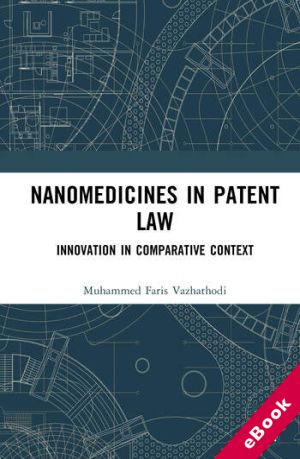
This book critically examines the evolving landscape of nanomedicine and its intersection with patent law, focusing on the Indian patent system in comparison with both US and EU frameworks.
Through a detailed scientific and legal analysis, this book explores whether nanomedicine inventions meet patentability criteria and examines how current regulations shape innovation in the field. It reveals that nanomedicine innovation, particularly in cancer therapeutics, is often driven by regulatory compliance rather than genuine therapeutic advancements. Empirical research, based on 1,500 patent claims and prosecution histories from the Indian Patent Office (IPO), the US Patent and Trademark Office (USPTO), and the European Patent Office (EPO), highlights significant gaps in IPO Manuals and guidelines. These inconsistencies have led to the grant of low-quality patents, potentially stifling innovation and undermining India’s patent regime. To address these challenges, the book proposes illustrative examples and tests for adequately examining nanomedicine patent claims, aimed at fostering high-quality patents and ensuring robust adjudication of nanomedicine inventions. It uses the IPO as a case study through which important lessons regarding patentability in nanotechnology can be learned.
This book will be of interest to researchers in the field of nanotechnology, intellectual property and patent law.










