
The eBooks we sell are sold as a single-user licence and are intended for the end user only.
The sale of some eBooks are restricted to certain countries. To alert you to such restrictions, please select the country of the billing address of your credit or debit card you wish to use for payment.
For further information see https://www.wildy.com/ebook-formats
Once the order is confirmed an e-mail will be sent to you to allow you to download the eBook. For UK purchases this will be automatic. For purchases outside the UK a member of staff will need to confirm the sale. (Staff are available to do this during normal business hours, Mon-Fri 8:30-17:00 UK time)
All eBooks are supplied firm sale and cannot be returned. If you believe there is a fault with your eBook then contact us on ebooks@wildy.com and we will help in resolving the issue. This does not affect your statutory rights.
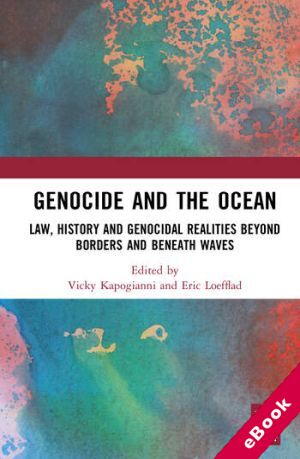
This collection explores the intricate legal, conceptual, and material relationship between genocide and the ocean. Traversing a wide range of topics, it brings into conversation numerous legal regimes that are too rarely considered in relation to one another–including, but not limited to, the international legal regime on genocide, international human rights and refugee law, the law of the sea, international cultural heritage law and environmental law, the law of self-determination, and the criminality of maritime violence.
Recognising that the relationship between genocide and the ocean exceeds what law alone can comprehensively capture through its own internal logic, contributors move beyond traditional doctrinal analysis to engage interdisciplinary perspectives. These include insights from criminology, geography/environmental science, moral/political philosophy, history, and international relations theory. Bringing together legal scholars and practitioners from across Europe, Latin America, Asia and the United States, this collection reflects both disciplinary and geographic diversity.
By bridging legal analysis with broader critical inquiry, this volume will be of interest to academics, researchers, and policy-makers working in the areas of International Criminal Law, International Human Rights Law, International Environmental Law, International Refugee Law, International Humanitarian Law, Legal History and the Law of the Sea.











