
The eBooks we sell are sold as a single-user licence and are intended for the end user only.
The sale of some eBooks are restricted to certain countries. To alert you to such restrictions, please select the country of the billing address of your credit or debit card you wish to use for payment.
For further information see https://www.wildy.com/ebook-formats
Once the order is confirmed an e-mail will be sent to you to allow you to download the eBook. For UK purchases this will be automatic. For purchases outside the UK a member of staff will need to confirm the sale. (Staff are available to do this during normal business hours, Mon-Fri 8:30-17:00 UK time)
All eBooks are supplied firm sale and cannot be returned. If you believe there is a fault with your eBook then contact us on ebooks@wildy.com and we will help in resolving the issue. This does not affect your statutory rights.
Due to a technical issue some ebooks are not available to order.
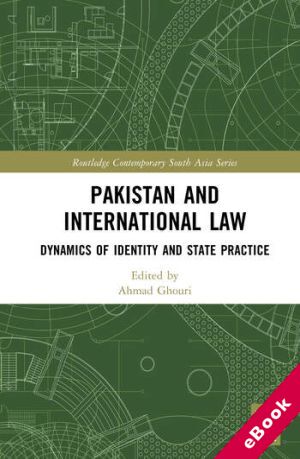
Pakistan and International Law: Dynamics of Identity and State Practice offers a pioneering exploration of Pakistan’s evolving relationship with international law.
Framed through the lens of state identity, this volume critically examines how Pakistan, as a post-colonial and Muslim-majority state, has engaged with, adapted to, and influenced international legal norms across diverse domains—from the UN system to individual rights and environmental protection, interstate arbitration, right to development, security, water, taxation and more. The book features contributions from leading scholars and practitioners, combining doctrinal analysis with critical perspectives rooted in Third World Approaches to International Law (TWAIL). It provides in-depth commentary on Pakistan’s legislative, judicial, and diplomatic practices, offering a rare state-specific study that fills a significant gap in international legal scholarship. Readers will gain a nuanced understanding of Pakistan’s legal landscape and its broader implications for global justice, legal pluralism, and the future of international law. It offers valuable insights into how international law operates in diverse cultural and political contexts, and how state identity shapes—and is shaped by—global legal norms.
The work will be of interest to academics, legal practitioners, policymakers, and students of international law, post-colonial legal studies, Islamic state practices, and South Asian geopolitics.










