
The eBooks we sell are sold as a single-user licence and are intended for the end user only.
The sale of some eBooks are restricted to certain countries. To alert you to such restrictions, please select the country of the billing address of your credit or debit card you wish to use for payment.
For further information see https://www.wildy.com/ebook-formats
Once the order is confirmed an e-mail will be sent to you to allow you to download the eBook. For UK purchases this will be automatic. For purchases outside the UK a member of staff will need to confirm the sale. (Staff are available to do this during normal business hours, Mon-Fri 8:30-17:00 UK time)
All eBooks are supplied firm sale and cannot be returned. If you believe there is a fault with your eBook then contact us on ebooks@wildy.com and we will help in resolving the issue. This does not affect your statutory rights.
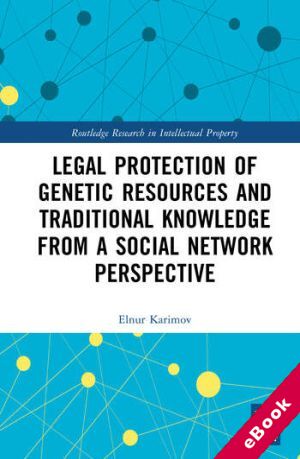
This book explores the urgent and evolving legal challenges surrounding the use of genetic resources and traditional knowledge (TK), particularly those held by Indigenous Peoples and local communities. International frameworks like the Nagoya Protocol and the 2024 WIPO Treaty aim to regulate benefit-sharing, but legal enforcement remains weak.
This book argues that traditional legal approaches (both international and national) alone are no longer sufficient and proposes a network-focused enforcement and compensation mechanism that uses social network analysis to examine the flow of genetic materials and TK through national and global supply chains. This approach is applied to 30 real-world biopiracy case studies across diverse regions, including Asia, Latin America, and Africa, to identify legal blind spots and power asymmetries. The book explains how predicting central nodes within supply chains where biopiracy and misappropriation are most likely to occur can lead to better enforcement and compensation outcomes. It then concludes with policy recommendations and suggestions to design more robust protection mechanisms for genetic resources and the associated TK.
This book will interest scholars of intellectual property and biotechnology law, as well as scholars of indigenous studies. Policymakers, indigenous activists, and social scientists who are interested in the broader applications of social network analysis will also find this of note.











