
The eBooks we sell are sold as a single-user licence and are intended for the end user only.
The sale of some eBooks are restricted to certain countries. To alert you to such restrictions, please select the country of the billing address of your credit or debit card you wish to use for payment.
For further information see https://www.wildy.com/ebook-formats
Once the order is confirmed an e-mail will be sent to you to allow you to download the eBook. For UK purchases this will be automatic. For purchases outside the UK a member of staff will need to confirm the sale. (Staff are available to do this during normal business hours, Mon-Fri 8:30-17:00 UK time)
All eBooks are supplied firm sale and cannot be returned. If you believe there is a fault with your eBook then contact us on ebooks@wildy.com and we will help in resolving the issue. This does not affect your statutory rights.
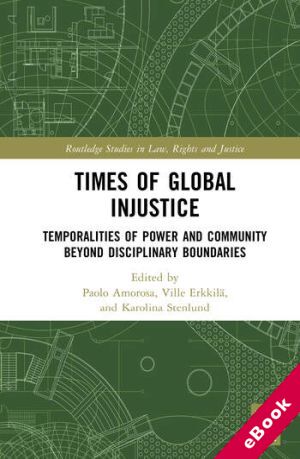
Time is an essential dimension of our shared understandings of the historical significance or fairness of a particular event or situation. The ways time is constructed, however, are characterised by a plurality of diverse and sometimes inconsistent representations. This book examines the uses of different conceptualizations of time in explaining injustice and justice in society from an interdisciplinary perspective. It is the temporal representations that are the focus of this book here: how and by whom are they constructed, how do they weave together or fray in the process of working through temporary or permanent injustices, and what spaces are made or quashed for different understandings of time? The volume gathers scholars from different backgrounds with expertise from law, history, politics and international relations, philosophy, and sociology to examine the temporality of (in)justice in society. The chapters of the book are integrated around a coherent central theme: the unavoidable intertwining of time and justice. As well as addressing the lived processes of collectively coming to terms with temporal experiences and justice, the book work also discusses the different disciplinary ways of making sense of such processes and the strengths and pitfalls of each approach.
The collection will be of interest to researchers and students of legal theory, international relations, global history, memory studies, and political philosophy.










