
The eBooks we sell are sold as a single-user licence and are intended for the end user only.
The sale of some eBooks are restricted to certain countries. To alert you to such restrictions, please select the country of the billing address of your credit or debit card you wish to use for payment.
For further information see https://www.wildy.com/ebook-formats
Once the order is confirmed an e-mail will be sent to you to allow you to download the eBook. For UK purchases this will be automatic. For purchases outside the UK a member of staff will need to confirm the sale. (Staff are available to do this during normal business hours, Mon-Fri 8:30-17:00 UK time)
All eBooks are supplied firm sale and cannot be returned. If you believe there is a fault with your eBook then contact us on ebooks@wildy.com and we will help in resolving the issue. This does not affect your statutory rights.
Due to a technical issue some ebooks are not available to order.
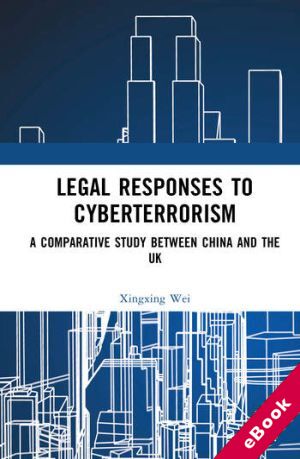
This book provides an in-depth comparative study of legal responses to cyberterrorism in China and the UK to establish whether the relationship between legal systems and legal responses is necessary or contingent in the case of counter-cyberterrorism. The work maps out and compares the basic distinctive characteristics of the legal systems in the two countries, which are characterised in terms of a contrast between ‘rule by law’ and `rule of law’, and basic criminal principles. It critically and comprehensively examines the basic principles of the legal responses to the perceived threats of cyberterrorism and identifies, through comparative analysis, any convergence as well as divergence. The study seeks to develop an understanding of what is necessary and contingent in the case of the relationship between legal systems and legal responses and considers what else might account for patterns of similarity as well as difference.
The book presents a distinct and original contribution to socio-legal studies generally, as well as to criminal justice and criminology in terms of the relationship between legal systems and legal responses to transnational problems, such as cyberterrorism. It will be a valuable resource for academics, researchers and policy-makers working in these areas.










