
The eBooks we sell are sold as a single-user licence and are intended for the end user only.
The sale of some eBooks are restricted to certain countries. To alert you to such restrictions, please select the country of the billing address of your credit or debit card you wish to use for payment.
For further information see https://www.wildy.com/ebook-formats
Once the order is confirmed an e-mail will be sent to you to allow you to download the eBook. For UK purchases this will be automatic. For purchases outside the UK a member of staff will need to confirm the sale. (Staff are available to do this during normal business hours, Mon-Fri 8:30-17:00 UK time)
All eBooks are supplied firm sale and cannot be returned. If you believe there is a fault with your eBook then contact us on ebooks@wildy.com and we will help in resolving the issue. This does not affect your statutory rights.
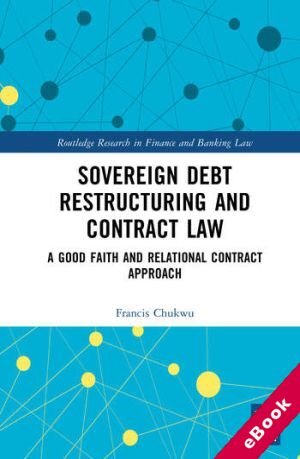
This book tackles the challenge of holdout creditor disruption of sovereign debt restructuring, where creditors reject collective agreements to pursue full loan recovery in domestic courts.
Critically examining the contemporary statutory and contractual approaches to sovereign debt restructuring, the book presents their usefulness and limitations, including the potential major impact of the doctrine of merger in rem judicatam. It proposes the duty of good faith (which is generally implied under U.S law, implied in certain categories of contract under English law, and widely recognized globally) applied in the context of sovereign debt as a relational contract, as a robust legal approach to combating such disruptions in domestic courts. Through rigorous analysis of case law and treatises, the book argues that sovereign debt contracts are relational contracts, invoking heightened good faith and equity obligations. With in-depth analysis of the contents and judicial applications of the duty of good faith in English and New York jurisprudence, it demonstrates how holdout actions violate good faith, and proffers a judicial approach, based on the duty of good faith, to sovereign debt restructuring as a viable alternative to current statutory and contractual approaches.
This book will be of interest to practitioners, researchers, and policy makers in contract law, finance law, relational contract theory, good faith, and sovereign debt.










