
The eBooks we sell are sold as a single-user licence and are intended for the end user only.
The sale of some eBooks are restricted to certain countries. To alert you to such restrictions, please select the country of the billing address of your credit or debit card you wish to use for payment.
For further information see https://www.wildy.com/ebook-formats
Once the order is confirmed an e-mail will be sent to you to allow you to download the eBook. For UK purchases this will be automatic. For purchases outside the UK a member of staff will need to confirm the sale. (Staff are available to do this during normal business hours, Mon-Fri 8:30-17:00 UK time)
All eBooks are supplied firm sale and cannot be returned. If you believe there is a fault with your eBook then contact us on ebooks@wildy.com and we will help in resolving the issue. This does not affect your statutory rights.
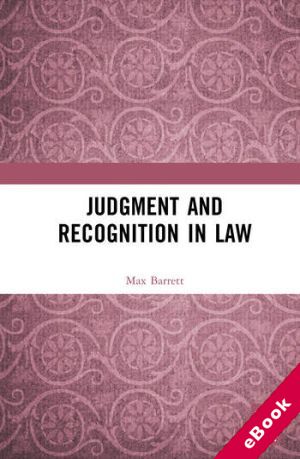
Justice begins in the fragments. While the legal system excels at classification and resolution, it often fails at recognition. Written from the bench by an Irish High Court judge, this book challenges the administrative sublime of modern bureaucracy, which sees persons too often converted into risk scores and bullet points.
Blending lived judicial experience with queer theory, literature, and philosophy, this book proposes a jurisprudence of attentive refusal to let the human disappear into procedural fluency. From piccolo paeans to global postage stamps to reflections on the moral motion of the soul, this book re-defines the judge’s task as being not just to decide, but to listen for the stutter and the shimmer that the official record can forget. Structured as a reflective journey across hemispheres – from the Global North to the Global South and back to Ireland – the book weaves the thoughts of various thinkers, from Aquinas and Baldwin to Butler and Muñoz, into a form of lyrical jurisprudence. Reflecting on the inner life of judging, that is to say the moral and imaginative dimensions of law as they unfold in attention, silence, and refusal, the book offers a companion to legal practice that invites readers to think again about what it means to judge, to recognise, and to stay near the lives that law touches. Judgment, it maintains, is not mere decision but an act of ethical attention, a form of seeing that keeps the human in view.
This book will appeal to academics and advanced students in the areas of jurisprudence, legal theory, ethics, and law and literature, as well as others with an interest in the ethics and practice of legal judgment.










