
Wildy Logo
(020) 7242 5778
enquiries@wildy.com

Book of the Month

Cover of McMeel on the Construction of Contracts: Interpretation, Implication and Rectification

McMeel on the Construction of Contracts: Interpretation, Implication and Rectification

Price: £225.00

Land Registration Manual
4th ed


 Ash Jones


Welcome to Wildys

Watch


Judicial Cooperation in Commercial Litigation 3rd ed (The British Cross-Border Financial Centre World)


 Ian Kawaley, David Doyle, Shade Subair Williams


Offers for Newly Called Barristers & Students

Special Discounts for Newly Called & Students

Read More ...


Secondhand & Out of Print

Browse Secondhand Online

Read More...


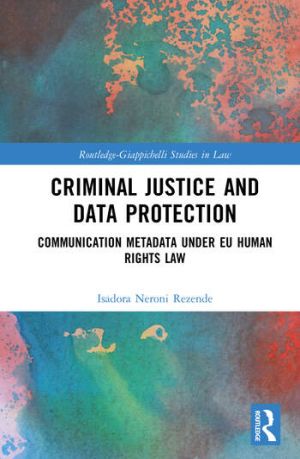
Criminal Justice and Data Protection: Communication Metadata under EU Human Rights Law


ISBN13: 9781041256489
To be Published: April 2026
Publisher: Routledge
Country of Publication: UK
Format: Hardback
Price: £145.00


The use of traffic and location data in criminal justice is now a common prac-tice in the EU and beyond. Although metadata do not reveal the contents of communications, they allow to draw precise conclusions on the private lives of users, like their everyday habits, places of residence, daily movements and ac-tivities, social relationships, and frequented environments. For this reason, they are largely used by law enforcement to identify promising targets of investiga-tion or as evidence in criminal trials. In the EU, national legislation often pro-vides for the indiscriminate retention of such data, but the compatibility of these mass surveillance regimes with the European human rights framework has been questioned in the case law of the European Court on Human Rights (ECtHR) and the European Court of Justice (CJEU), as well as legal scholar-ship. Nevertheless, the use of unlawfully retained data in criminal proceedings is not usually sanctioned in national criminal procedural systems.

This book addresses this problem by inquiring about how communications metadata can be used in criminal proceedings, having regard to the principles of legality and fairness. In particular, through the lens of fairness, the analysis seeks to find some common ground between privacy and data protection regimes on the one hand and criminal procedural rules on the other. To this end, it employs both an interdisciplinary doctrinal research method and a comparative analysis be-tween a limited number of EU Member States. By identifying different stand-ards of fairness for the preventive context, the investigation, and the trial phase, the book highlights gaps in protection and attempts to reconcile these two separate, yet closely related, regimes.


Subjects:
Criminal Law, Data Protection, EU Law
Contents:
Introduction

Part I: Setting the Scene of the Analysis in a Complex Legal Framework
1. Communications Metadata and Fundamental Rights in the Criminal Domain
2. Methodology: Aligning Privacy, Data Protection And Criminal Procedure through Fairness

Part II: Preventive Acquisition of Communications Metadata
3. Preventive Surveillance in the Convention
4. Preventive Surveillance in the European Union
5. Interception and Retention of Communications Metadata in Europe

Part III: Communication Metadata in Criminal Investigations
6. From Preventive Operations to Criminal Investigations
7. Access and Interception of Communications Metadata

Part IV: Communication Metadata as Evidence at Trial
8. The Admissibility of Communications Metadata as Evidence
9. Effective Remedies for the Fair Use of Communications Metadata as Evidence
10. Conclusion







