
Wildy Logo
(020) 7242 5778
enquiries@wildy.com

Book of the Month

Cover of McMeel on the Construction of Contracts: Interpretation, Implication and Rectification

McMeel on the Construction of Contracts: Interpretation, Implication and Rectification

Price: £225.00

Land Registration Manual
4th ed


 Ash Jones


Welcome to Wildys

Watch


Judicial Cooperation in Commercial Litigation 3rd ed (The British Cross-Border Financial Centre World)


 Ian Kawaley, David Doyle, Shade Subair Williams


Offers for Newly Called Barristers & Students

Special Discounts for Newly Called & Students

Read More ...


Secondhand & Out of Print

Browse Secondhand Online

Read More...


2025-6 Christmas and New Year Closing

We are now closed for the Christmas and New Year period, returning on Monday 5th January 2026. Orders placed during this time will be processed upon our return on 5th January.

Hide this message

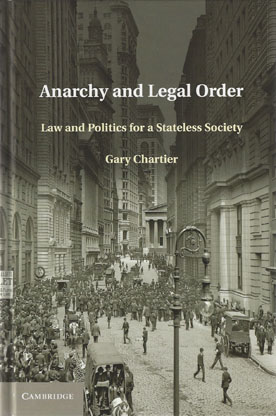
Anarchy and Legal Order: Law and Politics for a Stateless Society


ISBN13: 9781107032286
Published: January 2013
Publisher: Cambridge University Press
Country of Publication: UK
Format: Hardback
Price: £114.00
Paperback edition , ISBN13 9781107661615


Despatched in 7 to 9 days.

This book elaborates and defends the idea of law without the state. Animated by a vision of peaceful, voluntary cooperation as a social ideal and building on a careful account of non-aggression, it features a clear explanation of why the state is illegitimate, dangerous and unnecessary. It proposes an understanding of how law enforcement in a stateless society could be legitimate and what the optimal substance of law without the state might be, suggests ways in which a stateless legal order could foster the growth of a culture of freedom, and situates the project it elaborates in relation to leftist, anti-capitalist and socialist traditions.


Subjects:
Constitutional and Administrative Law, Law and Society
Contents:
1. Laying foundations
2. Rejecting aggression
3. Safeguarding cooperation
4. Enforcing law
5. Rectifying injury
6. Liberating society
7. Situating liberation.







