
The eBooks we sell are sold as a single-user licence and are intended for the end user only.
The sale of some eBooks are restricted to certain countries. To alert you to such restrictions, please select the country of the billing address of your credit or debit card you wish to use for payment.
For further information see https://www.wildy.com/ebook-formats
Once the order is confirmed an e-mail will be sent to you to allow you to download the eBook. For UK purchases this will be automatic. For purchases outside the UK a member of staff will need to confirm the sale. (Staff are available to do this during normal business hours, Mon-Fri 8:30-17:00 UK time)
All eBooks are supplied firm sale and cannot be returned. If you believe there is a fault with your eBook then contact us on ebooks@wildy.com and we will help in resolving the issue. This does not affect your statutory rights.
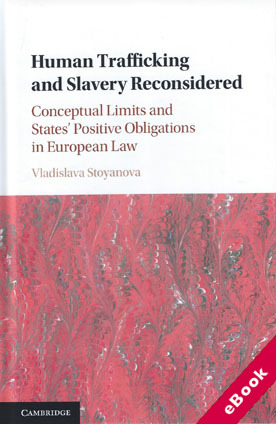
By reconsidering the definitions of human trafficking, slavery, servitude and forced labour, Vladislava Stoyanova demonstrates how, in embracing the human trafficking framework, the international community has side-lined the human rights law commitments against slavery, servitude and forced labour that in many respects provide better protection for abused migrants.
Stoyanova proposes two corrective steps to this development: placing a renewed emphasis on determining the definitional scope of slavery, servitude or forced labour, and gaining a clearer understanding of states' positive human rights obligations.
This book compares anti-trafficking and human rights frameworks side-by-side and focuses its analysis on the Council of Europe's Trafficking Convention and Article 4 of the ECHR. With innovative arguments and pertinent case studies, this book is an important contribution to this field and will appeal to students, scholars and legal practitioners interested in human rights law, migration law, criminal law and EU law.










