
The eBooks we sell are sold as a single-user licence and are intended for the end user only.
The sale of some eBooks are restricted to certain countries. To alert you to such restrictions, please select the country of the billing address of your credit or debit card you wish to use for payment.
For further information see https://www.wildy.com/ebook-formats
Once the order is confirmed an e-mail will be sent to you to allow you to download the eBook. For UK purchases this will be automatic. For purchases outside the UK a member of staff will need to confirm the sale. (Staff are available to do this during normal business hours, Mon-Fri 8:30-17:00 UK time)
All eBooks are supplied firm sale and cannot be returned. If you believe there is a fault with your eBook then contact us on ebooks@wildy.com and we will help in resolving the issue. This does not affect your statutory rights.
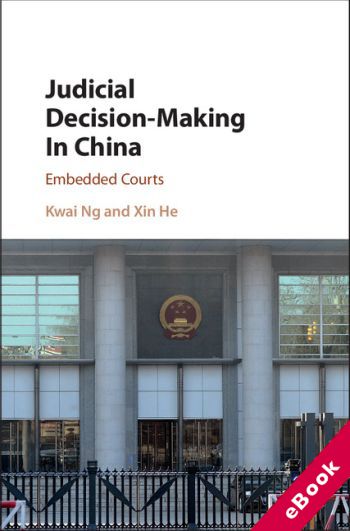
Judicial decision-making in China is laden with tension. Chinese courts are organized as a singular and unified system yet grassroots courts in urban and rural regions differ greatly in the way they use the law and are as diverse as the populations they serve.
Based on extensive fieldwork and in-depth interviews, this book offers a penetrating discussion of the operation of Chinese courts. It explains how Chinese judges rule and how the law is not the only script they follow - political, administrative, social and economic factors all influence verdicts.
This landmark work will revise our understanding of the role of law in China - one that cannot be easily understood through the standard lens of judicial independence and separation of powers. Ng and He make clear the struggle facing frontline judges as they bridge the gap between a rule-based application of law and an instrumentalist view that prioritizes stability maintenance.










