Wildy Logo
(020) 7242 5778
enquiries@wildy.com

Book of the Month

Cover of Constitutional Agency

Constitutional Agency

Price: £105.00

Planning Law:
A Practitioner's
Handbook 2nd ed


 William Webster, Robert Weatherley


Welcome to Wildys

Watch


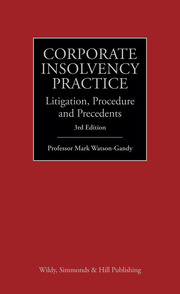
Corporate Insolvency Practice:
Litigation, Procedure
and Precedents 3rd ed


 Mark Watson-Gandy


Offers for Newly Called Barristers & Students

Special Discounts for Newly Called & Students

Read More ...


Secondhand & Out of Print

Browse Secondhand Online

Read More...


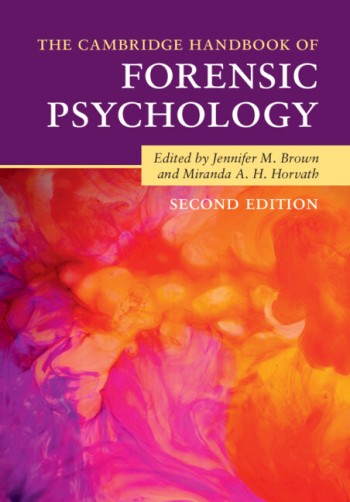
The Cambridge Handbook of Forensic Psychology 2nd ed

Edited by: Jennifer M Brown, Miranda A. H. Horvath

ISBN13: 9781108494977
Published: December 2021
Publisher: Cambridge University Press
Country of Publication: UK
Format: Hardback
Price: £166.00
Paperback edition , ISBN13 9781108816748


This is a Print On Demand Title.

The publisher will print a copy to fulfill your order. Books can take between 1 to 3 weeks. Looseleaf titles between 1 to 2 weeks.

In the decade since the publication of the first edition of The Cambridge Handbook of Forensic Psychology, the field has expanded into areas such as social work and education, while maintaining the interest of criminal justice researchers and policy makers. This new edition provides cutting-edge and comprehensive coverage of the key theoretical perspectives, assessment methods, and interventions in forensic psychology.

The contributors address substantive topics such as acquisitive crime, domestic violence, mass murder, and sexual violence, while also exploring emerging areas of research such as the expansion of cybercrime, particularly child sexual exploitation, as well as aspects of terrorism and radicalisation. Reflecting the global reach of forensic psychology and its wide range of perspectives, the international team of contributors emphasise diversity and cross-reference between adults, adolescents, and children to deliver a contemporary picture of the discipline.

  • Provides an up-to-date analysis of controversies in terrorism research
  • Takes account of lessons from indigenous restorative justice resolutions
  • Supplies chapters on theories, assessments, and interventions with violent offenders
  • Contains practical guidance for continuing professional development
  • Brings together perspectives from different countries showing where similarities and differences exist
  • Covers contemporary topics such as asylum seekers, victims of crime, and female offenders

Subjects:
Criminology
Contents:
Preface
Forensic psychology: ten years on, Jennifer M. Brown and Miranda A. H. Horvath

Part I. Psychological Underpinnings:
1.1 Cognitive theories of crime,Clive R. Hollin
1.2 Child and adolescent offending, Elizabeth Paddock, Shihning Chou and Kevin Browne
1.3 Investigative psychology, C. Gabrielle Salfati
1.4 Neurological theories, Hope Kent, Huw Williams and James Tonks
1.5 Personality, Sean Hammond and Vincent Egan
1.6 Theories of sexual offending, Jacinta R. Cording and Tony Ward
1.7 The psychology of violent behaviour, Andrew Welsh
1.8 Investigative decision-making, Rebecca Howman, Marie Eyre and Laurence Alison

Part II. Psychology and Criminal Behaviour:
2.1 Current understandings of sex-based harassment and stalking perpetration, Thomas E. Page and Adrian Scott
2.2 The behaviour of sex offenders, Kari Davies, Heather Flowe and Theresa Ferraz-da-Silva
2.3 Intimate partner violence, Elizabeth Gilchrist
2.4 Acquisitive crime, Helen Gavin
2.5 Terrorism research: current issues and debates, Margaret A. Wilson
2.6 Online child sexual exploitation and abuse, Ethel Quayle
2.7 Arson, Katarina Fritzon, Sarah Miller and Danielle Perks
2.8 Serial killings and mass murder, Andreas Kapardis and Sasha Reid

Part III. Assessment:
3.1 Credibility and investigative interviewing, Mark Kebbell and Rebecca Milne
3.2 Eyewitness testimony, Geralda Odinot, Eva A. J. van Rosmalen, and Annelies Vredeveldt
3.3 Psychopathic personality disorder, David J. Cooke
3.4 Forensic mental health assessments, Derek Perkins and Susannah Hughes
3.5 Intellectual disabilities and offending behaviour, John L. Taylor and Ian Freckleton
3.6 Head injury and offending Thomas M. McMillan
3.7 Parole decision-making: contemporary practice and challenges, Ralph C. Serin and Kaitlyn Wardrop
3.8 Risk and dangerousness in adults, Martin Rettenberger, Grant T. Harris, Marnie E. Rice and Reinhard Eher

Part IV. Interventions:
4.1 Forensic mental health interventions, Emily Glorney
4.2 Restorative justice: drawing from the old to develop new justice alternatives, Mark Briskey
4.3 Treatment of persons with sexual offence histories, Kristina Shatokhina and Leigh Harkins
4.4 Strength-based approaches to addiction recovery and desistance from crime: broadening the base for community engagement, Steve Broome and David Best
4.5 Victimology and victim interventions, Sandra Walklate
4.6 Interventions with violent offenders, Devon L. L. Polaschek
4.7 Women offenders, Joanne Belknap and Jacqueline Mora Manzo
4.8 Preventing delinquency and later criminal offending, Brandon C. Welsh, David P. Farrington and Alexis Yohros

Part V. Civil Proceedings:
5.1 Court decisions about the upbringing of children, Aoife Daly and Aisling Parkes
5.2 Parenting, Christine Puckering
5.3 Immigration, asylum seekers and refugees, Nora Honkala
5.4 Occupational stress and traumatic stress, Paula Brough, Amanda Biggs, Briana Brandon and Victoria Follette
5.5 Capacity and consent in the criminal and civil contexts, Ailbhe O'Loughlin

Part VI. Professional Practices:
6.1 Courtroom testimony in cases of disputed confessions, Gisli H. Gudjonsson
6.2 Evaluating offending behaviour programmes in prison and probation, Helen Wakeling and Rosie Travers
6.3 Working effectively with multicultural offenders in a clinical context, Stephane Shepherd, Arran Rose and Mary Madu
6.4 Professional training and accreditation, Geraldine O'Hare, Andrew Day, Randy Otto and Laura Guy
6.5 Ethics, Simon Duff and James McGuire
6.6 Forensic case formulation, Leam A. Craig and Martin Rettenberger
6.7 Staff supervision in forensic contexts, Jason Davies.