
The eBooks we sell are sold as a single-user licence and are intended for the end user only.
The sale of some eBooks are restricted to certain countries. To alert you to such restrictions, please select the country of the billing address of your credit or debit card you wish to use for payment.
For further information see https://www.wildy.com/ebook-formats
Once the order is confirmed an e-mail will be sent to you to allow you to download the eBook. For UK purchases this will be automatic. For purchases outside the UK a member of staff will need to confirm the sale. (Staff are available to do this during normal business hours, Mon-Fri 8:30-17:00 UK time)
All eBooks are supplied firm sale and cannot be returned. If you believe there is a fault with your eBook then contact us on ebooks@wildy.com and we will help in resolving the issue. This does not affect your statutory rights.
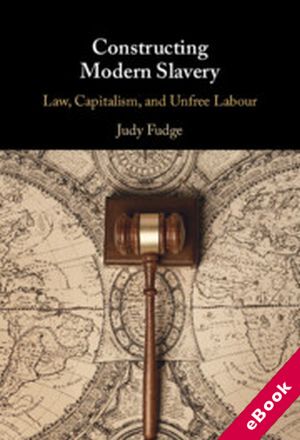
Modern slavery laws are a response to global capitalism, which undermines the distinction between free and unfree labour and poses intense challenges to state sovereignty. Instead of being a solution, Constructing Modern Slavery argues that modern slavery laws divert attention from the underlying structures and processes that generate exploitation. Focusing on unfree labour associated with international immigration and global supply chains, it provides a novel socio-legal genealogy of the concept 'modern slavery' through a series of linked case studies of influential actors associated with key legal instruments: the United Nations, the United States, the International Labour Organization, the European Union, the United Kingdom, and Walk Free Foundation.
Constructing Modern Slavery demonstrates that despite the best efforts of academics, advocates, and policymakers to develop a truly multifaceted approach to modern slavery, it is difficult to uncouple antislavery initiatives from the conservative moral and economic agendas with which they are aligned.











