
The eBooks we sell are sold as a single-user licence and are intended for the end user only.
The sale of some eBooks are restricted to certain countries. To alert you to such restrictions, please select the country of the billing address of your credit or debit card you wish to use for payment.
For further information see https://www.wildy.com/ebook-formats
Once the order is confirmed an e-mail will be sent to you to allow you to download the eBook. For UK purchases this will be automatic. For purchases outside the UK a member of staff will need to confirm the sale. (Staff are available to do this during normal business hours, Mon-Fri 8:30-17:00 UK time)
All eBooks are supplied firm sale and cannot be returned. If you believe there is a fault with your eBook then contact us on ebooks@wildy.com and we will help in resolving the issue. This does not affect your statutory rights.
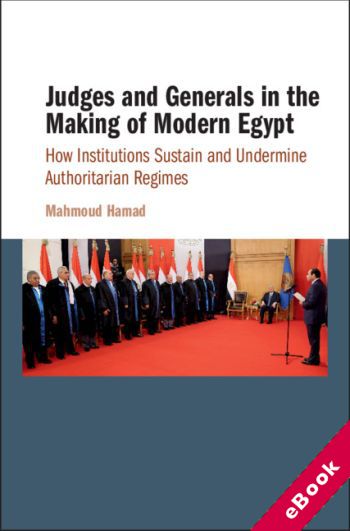
Why do authoritarian regimes survive? How do dictators fail? What role do political institutions play in these two processes? Many of the answers to these questions can be traced to the same source: the interaction between institutions and preferences.
Using Egypt as a case study, Professor Mahmoud Hamad describes how the synergy between judges and generals created the environment for the present government and a delicate balance for its survival. The history of modern Egypt is one of the struggle between authoritarian governments, and forces that advocate for more democratic rights. While the military has provided dictatorial leaders, the judiciary provides judges who have the power to either support or stymie authoritarian power.
Judges and Generals in the Making of Modern Egypt provides a historically grounded explanation for the rise and demise of authoritarianism, and is one of the first studies of Egypt's judicial institutions within a single analytical framework.










