The eBooks we sell are sold as a single-user licence and are intended for the end user only.
The sale of some eBooks are restricted to certain countries. To alert you to such restrictions, please select the country of the billing address of your credit or debit card you wish to use for payment.
For further information see https://www.wildy.com/ebook-formats
Once the order is confirmed an e-mail will be sent to you to allow you to download the eBook. For UK purchases this will be automatic. For purchases outside the UK a member of staff will need to confirm the sale. (Staff are available to do this during normal business hours, Mon-Fri 8:30-17:00 UK time)
All eBooks are supplied firm sale and cannot be returned. If you believe there is a fault with your eBook then contact us on ebooks@wildy.com and we will help in resolving the issue. This does not affect your statutory rights.
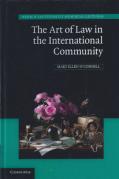
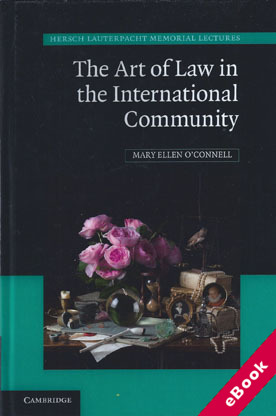
International law evolved to end and prevent armed conflict as much as for any other reason. Yet, the law against war appears weaker today than ever in its long history, evidenced by raging armed conflicts in which people are killed, injured, and forcibly displaced.
The environment is devastated, and the planet impoverished. These consequences can be traced to the dominant ideology of realism. In 1946, Hersch Lauterpacht challenged that ideology by contrasting it with the idea of international law, composed of natural law, positive law, and process theory.
The Art of Law in the International Community revives his vision, rebuilding the understanding of why international law binds, what its norms require, and how courts are the ideal substitutes for war. The secret to the renewal of international law lies in revitalising the moral foundation of natural law through drawing on aesthetic philosophy and the arts.