
The eBooks we sell are sold as a single-user licence and are intended for the end user only.
The sale of some eBooks are restricted to certain countries. To alert you to such restrictions, please select the country of the billing address of your credit or debit card you wish to use for payment.
For further information see https://www.wildy.com/ebook-formats
Once the order is confirmed an e-mail will be sent to you to allow you to download the eBook. For UK purchases this will be automatic. For purchases outside the UK a member of staff will need to confirm the sale. (Staff are available to do this during normal business hours, Mon-Fri 8:30-17:00 UK time)
All eBooks are supplied firm sale and cannot be returned. If you believe there is a fault with your eBook then contact us on ebooks@wildy.com and we will help in resolving the issue. This does not affect your statutory rights.
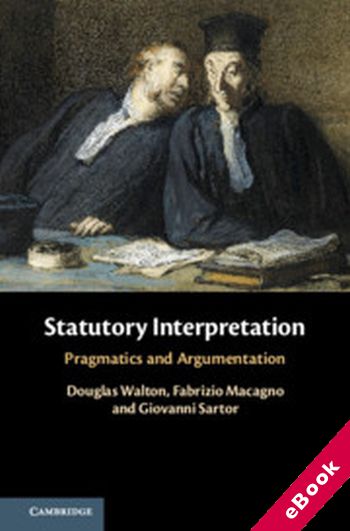
Statutory interpretation involves the reconstruction of the meaning of a legal statement when it cannot be considered as accepted or granted. This phenomenon needs to be considered not only from the legal and linguistic perspective, but also from the argumentative one - which focuses on the strategies for defending a controversial or doubtful viewpoint. This book draws upon linguistics, legal theory, computing, and dialectics to present an argumentation-based approach to statutory interpretation. By translating and summarizing the existing legal interpretative canons into eleven patterns of natural arguments - called argumentation schemes - the authors offer a system of argumentation strategies for developing, defending, assessing, and attacking an interpretation.
Illustrated through major cases from both common and civil law, this methodology is summarized in diagrams and maps for application to computer sciences. These visuals help make the structures, strategies, and vulnerabilities of legal reasoning accessible to both legal professionals and laypeople.











