
The eBooks we sell are sold as a single-user licence and are intended for the end user only.
The sale of some eBooks are restricted to certain countries. To alert you to such restrictions, please select the country of the billing address of your credit or debit card you wish to use for payment.
For further information see https://www.wildy.com/ebook-formats
Once the order is confirmed an e-mail will be sent to you to allow you to download the eBook. For UK purchases this will be automatic. For purchases outside the UK a member of staff will need to confirm the sale. (Staff are available to do this during normal business hours, Mon-Fri 8:30-17:00 UK time)
All eBooks are supplied firm sale and cannot be returned. If you believe there is a fault with your eBook then contact us on ebooks@wildy.com and we will help in resolving the issue. This does not affect your statutory rights.
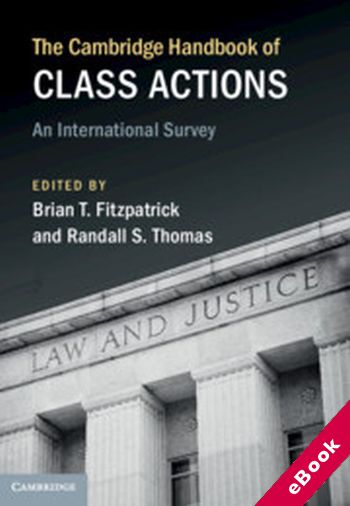
Economic activity is more globally integrated than ever before, but so is the scope of corporate misconduct. As more and more people across the world are affected by such malfeasance, the differences in legal redress have become increasingly visible. This transparency has resulted in a growing convergence towards an American model of robust private enforcement of the law, including the class-action lawsuit. This handbook brings together scholars from nearly two dozen countries to describe and assess the class-action procedure (or its equivalent) in their respective countries and, where possible, to offer empirical data on these systems. At the same time, the work presents a variety of multidisciplinary perspectives on class actions, from economics to philosophy, making this handbook an essential resource to academics, lawyers, and policymakers alike.
The first scholarly work to gather and consolidate data on aggregate litigation from across the globe Covers the most active class action jurisdictions, as well as those with unique features, such as the constitutional guarantee in South Africa and the use of arbitration in Brazil Discusses who can initiate the class action procedure, in what kinds of cases, and for what types of relief










