
The eBooks we sell are sold as a single-user licence and are intended for the end user only.
The sale of some eBooks are restricted to certain countries. To alert you to such restrictions, please select the country of the billing address of your credit or debit card you wish to use for payment.
For further information see https://www.wildy.com/ebook-formats
Once the order is confirmed an e-mail will be sent to you to allow you to download the eBook. For UK purchases this will be automatic. For purchases outside the UK a member of staff will need to confirm the sale. (Staff are available to do this during normal business hours, Mon-Fri 8:30-17:00 UK time)
All eBooks are supplied firm sale and cannot be returned. If you believe there is a fault with your eBook then contact us on ebooks@wildy.com and we will help in resolving the issue. This does not affect your statutory rights.
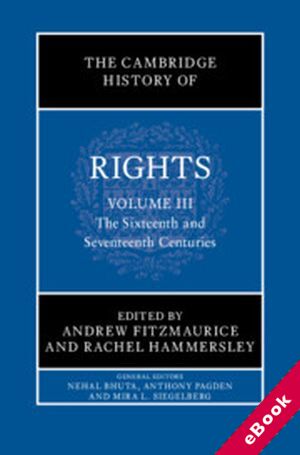
In the sixteenth and seventeenth centuries, contemporary authors explored the myriad ways in which the concept of rights could be understood, but almost always arrived at the same conclusion: it was vital that rights should never be conflated with power. Through twenty-six expertly written essays, volume three of The Cambridge History of Rights focuses on the language of rights, exploring its use in contexts as diverse as the English family, trading relations and Asian powers. This was a period in which rights came to the forefront of political discourse, making it crucial to the longer history of rights reflected in this series.
By foregrounding the idea of rights in action, the volume considers the relationship between the ways in which rights were articulated – by individuals, institutions and states – and how they were enacted in practice. In doing so, it uncovers the complexities inherent in the development of the language of rights during this formative period.










