
The eBooks we sell are sold as a single-user licence and are intended for the end user only.
The sale of some eBooks are restricted to certain countries. To alert you to such restrictions, please select the country of the billing address of your credit or debit card you wish to use for payment.
For further information see https://www.wildy.com/ebook-formats
Once the order is confirmed an e-mail will be sent to you to allow you to download the eBook. For UK purchases this will be automatic. For purchases outside the UK a member of staff will need to confirm the sale. (Staff are available to do this during normal business hours, Mon-Fri 8:30-17:00 UK time)
All eBooks are supplied firm sale and cannot be returned. If you believe there is a fault with your eBook then contact us on ebooks@wildy.com and we will help in resolving the issue. This does not affect your statutory rights.
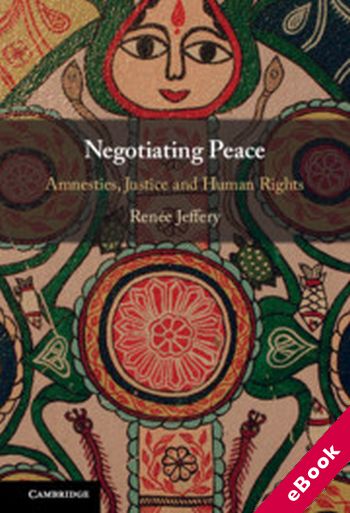
In the past two decades, peace negotiators around the world have increasingly accepted that granting amnesties for human rights violations is no longer an acceptable bargaining tool or incentive, even when the signing of a peace agreement is at stake. While many states that previously saw sweeping amnesties as integral to their peace processes now avoid amnesties for human rights violations, this anti-amnesty turn has been conspicuously absent in Asia. In Negotiating Peace: Amnesties, Justice and Human Rights, Renée Jeffery examines why peace negotiators in Asia have resisted global anti-impunity measures more fervently and successfully than their counterparts around the world. Drawing on a new global dataset of 146 peace agreements (1980–2015) and with in-depth analysis of four key cases - Timor-Leste, Aceh Indonesia, Nepal and the Philippines - Jeffery uncovers the legal, political, economic and cultural reasons for the persistent popularity of amnesties in Asian peace processes.










