
The eBooks we sell are sold as a single-user licence and are intended for the end user only.
The sale of some eBooks are restricted to certain countries. To alert you to such restrictions, please select the country of the billing address of your credit or debit card you wish to use for payment.
For further information see https://www.wildy.com/ebook-formats
Once the order is confirmed an e-mail will be sent to you to allow you to download the eBook. For UK purchases this will be automatic. For purchases outside the UK a member of staff will need to confirm the sale. (Staff are available to do this during normal business hours, Mon-Fri 8:30-17:00 UK time)
All eBooks are supplied firm sale and cannot be returned. If you believe there is a fault with your eBook then contact us on ebooks@wildy.com and we will help in resolving the issue. This does not affect your statutory rights.
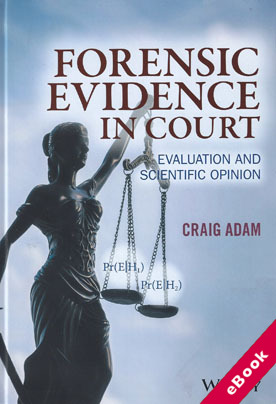
The interpretation and evaluation of scientific evidence and its presentation in a court of law is central both to the role of the forensic scientist as an expert witness and to the interests of justice.
This book aims to provide a thorough and detailed discussion of the principles and practice of evidence interpretation and evaluation by using real cases by way of illustration. The presentation is appropriate for students of forensic science or related disciplines at advanced undergraduate and master's level or for practitioners engaged in continuing professional development activity.
The book is structured in three sections. The first sets the scene by describing and debating the issues around the admissibility and reliability of scientific evidence presented to the court. In the second section, the principles underpinning interpretation and evaluation are explained, including discussion of those formal statistical methods founded on Bayesian inference.
The following chapters present perspectives on the evaluation and presentation of evidence in the context of a single type or class of scientific evidence, from DNA to the analysis of documents. For each, the science underpinning the analysis and interpretation of the forensic materials is explained, followed by the presentation of cases which illustrate the variety of approaches that have been taken in providing expert scientific opinion.











