
The eBooks we sell are sold as a single-user licence and are intended for the end user only.
The sale of some eBooks are restricted to certain countries. To alert you to such restrictions, please select the country of the billing address of your credit or debit card you wish to use for payment.
For further information see https://www.wildy.com/ebook-formats
Once the order is confirmed an e-mail will be sent to you to allow you to download the eBook. For UK purchases this will be automatic. For purchases outside the UK a member of staff will need to confirm the sale. (Staff are available to do this during normal business hours, Mon-Fri 8:30-17:00 UK time)
All eBooks are supplied firm sale and cannot be returned. If you believe there is a fault with your eBook then contact us on ebooks@wildy.com and we will help in resolving the issue. This does not affect your statutory rights.
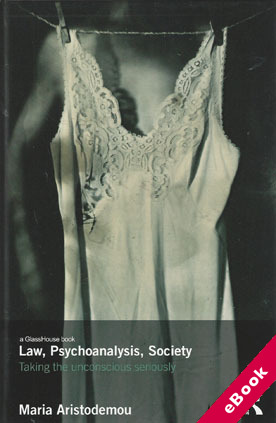
'If God is dead, everything is permitted', says Dostoyevsky's Ivan Karamazov. 'If God is dead, everything is prohibited', responds Lacan. 'I swear to tell the truth, the whole truth, and nothing but the truth' we say in a court of law. 'In a court of law, the truth is precisely what we will not say', says Lacan. 'I think, therefore I am', says Descartes. 'I am where I do not think', responds Lacan.
What are we to make of Lacan's inversions of these famous mottos? And what are the implications for the legal system if we take them seriously? This book takes these puzzles, and the hypothesis of the unconscious seriously and puts the legal subject on the couch. It listens to her monotonous ramblings, excavates and illustrates her unconscious desires and watches the patient start seeing herself otherwise.
The analysis leads her to start questioning her own long-held beliefs and precious identifications: terms like 'truth', 'guilt', 'reason', 'interpretation', reality', 'freedom', 'punishment', 'evidence', 'responsibility', 'ethics', 'human rights', 'morality' acquire new and surprising meanings. By the end of these sessions, the patient is left wondering, along with Freud her analyst, whether 'it is not psychology that deserves the mockery but the procedure of judicial enquiry'.
In its exploration into the incestuous relationship between law and desire, enjoyment and transgression, truth and lies, freedom and subservience, ethics and atheism, this book provides a step-by-step analysis of those central psychoanalytic concepts that problematize fundamental tenets of the legal system.










