
The eBooks we sell are sold as a single-user licence and are intended for the end user only.
The sale of some eBooks are restricted to certain countries. To alert you to such restrictions, please select the country of the billing address of your credit or debit card you wish to use for payment.
For further information see https://www.wildy.com/ebook-formats
Once the order is confirmed an e-mail will be sent to you to allow you to download the eBook. For UK purchases this will be automatic. For purchases outside the UK a member of staff will need to confirm the sale. (Staff are available to do this during normal business hours, Mon-Fri 8:30-17:00 UK time)
All eBooks are supplied firm sale and cannot be returned. If you believe there is a fault with your eBook then contact us on ebooks@wildy.com and we will help in resolving the issue. This does not affect your statutory rights.
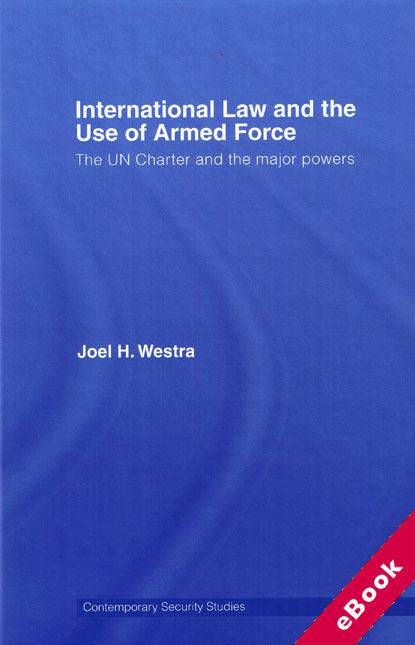
This book examines how the UN Charter’s prohibition of force restrains the actions of the major powers, treating the Charter as both an instrument of international peace and international order.
Since the Charter came into effect in 1945, there have been numerous incidents in which one or more of the five major powers have violated the Charter’s Article 2(4) prohibition of force. Given the frequency of these illegal uses of armed force, how does the Charter’s prohibition of force function as a restraint upon the actions of the major powers? The recent Iraq War and other incidents have demonstrated the major powers’ continued willingness to use armed force against other states, but the effects that the Charter’s prohibition of force has had in such incidents have not been examined thoroughly.
International Law and the Use of Armed Force examines five historical cases: US intervention in the Caribbean 1953-61, Franco-British intervention in Egypt in 1956, Soviet intervention in Hungary in 1956, US-British intervention in Iraq 1990-98 and US-British intervention in Iraq 1999-2003










