
The eBooks we sell are sold as a single-user licence and are intended for the end user only.
The sale of some eBooks are restricted to certain countries. To alert you to such restrictions, please select the country of the billing address of your credit or debit card you wish to use for payment.
For further information see https://www.wildy.com/ebook-formats
Once the order is confirmed an e-mail will be sent to you to allow you to download the eBook. For UK purchases this will be automatic. For purchases outside the UK a member of staff will need to confirm the sale. (Staff are available to do this during normal business hours, Mon-Fri 8:30-17:00 UK time)
All eBooks are supplied firm sale and cannot be returned. If you believe there is a fault with your eBook then contact us on ebooks@wildy.com and we will help in resolving the issue. This does not affect your statutory rights.
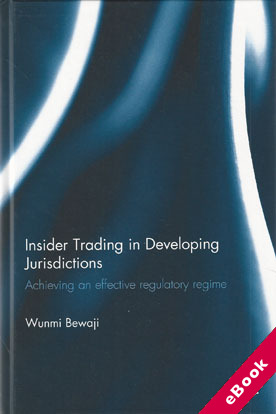
The book examines the regulation of insider dealing in the developed jurisdictions, using three of the G7 countries as guides with the aim of knowing how they have regulated insider trading and what lessons can be learnt from their failures and achievements.
It looks at regulatory regimes in the US, the UK and Japan in order to consider whether these regimes can be successfully transplanted to developing countries. In order to explore insider dealing in the developing world the book focuses on Nigeria, Africa's most populous nation and second largest economy.
This book examines in theoretical and empirical terms the law on insider trading away from the dogmatic approach of Western literature by presenting the subject from the prism of a developing jurisdiction in post-colonial Africa with a divergent cultural, historical, social, political and economic background. The author analyses what shape insider dealing takes in Nigeria, a predominantly illiterate society, and considers the groups involved.
The books also explores how the concept of insider dealing regulation is understood amongst parties integral to its administration and enforcement such as lawyers, judges, stockbrokers, and ordinary investors. The legislation governing insider dealing regulation in Nigeria is critically examined to expose its strengths and weaknesses, and to see how foreign provisions and legislation have been incorporated.
The book uses Nigerian experiences to consider its implications for other developing nations, arguing that regulatory regimes need to take into account the specific social, political, historical and economic factors of a particular locale rather than importing regulations wholesale from developed jurisdictions.










