
The eBooks we sell are sold as a single-user licence and are intended for the end user only.
The sale of some eBooks are restricted to certain countries. To alert you to such restrictions, please select the country of the billing address of your credit or debit card you wish to use for payment.
For further information see https://www.wildy.com/ebook-formats
Once the order is confirmed an e-mail will be sent to you to allow you to download the eBook. For UK purchases this will be automatic. For purchases outside the UK a member of staff will need to confirm the sale. (Staff are available to do this during normal business hours, Mon-Fri 8:30-17:00 UK time)
All eBooks are supplied firm sale and cannot be returned. If you believe there is a fault with your eBook then contact us on ebooks@wildy.com and we will help in resolving the issue. This does not affect your statutory rights.
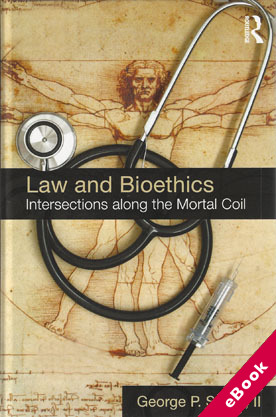
George P. Smith, II is a leading figure in the world of medical law and ethics. During his long career he has addressed some of the most important issues in bioethics and has contributed much original thought to debates in the field. This book celebrates his contribution to scholarship in this area and brings together his key writings in bioethics.
The chapters include previously published material which has been substantially updated to reflect recent developments in medicine and law. The book covers topics such as: human rights and medical law; the allocation of resources and distributive justice; ethical relativism; science and religion; and public health emergencies.
Taken as a whole, this book examines the extent to which law, medicine, economics, and bioethics interact as synergistic vectors of force in shaping and setting both personal and public responses to the complexities of biotechnology, or what has been referred to as 'The New Biology.'
All too often, past considerations of this topic have neglected to recognise the synergistic influences of law as a catalyst for codifying contemporary values into normative standards. Professor Smith reaches the conclusion that if traditional bioethical principles are to be seen as pertinent constructs for policy making, they must be broadened through the law of public health and Human rights.
Law and Bioethics: Intersections along the Mortal Coil casts law as the pivotal force in bringing stability to the ongoing debates on how to maintain bioethical relevance in decision making and in so doing, it offers an excellent overview of the current bioethical issues in medical law considered in light of recent and ongoing technological developments in medicine. This book will be of particular interest to academics and students of Law, Political Science, Philosophy and Economics.










