
The eBooks we sell are sold as a single-user licence and are intended for the end user only.
The sale of some eBooks are restricted to certain countries. To alert you to such restrictions, please select the country of the billing address of your credit or debit card you wish to use for payment.
For further information see https://www.wildy.com/ebook-formats
Once the order is confirmed an e-mail will be sent to you to allow you to download the eBook. For UK purchases this will be automatic. For purchases outside the UK a member of staff will need to confirm the sale. (Staff are available to do this during normal business hours, Mon-Fri 8:30-17:00 UK time)
All eBooks are supplied firm sale and cannot be returned. If you believe there is a fault with your eBook then contact us on ebooks@wildy.com and we will help in resolving the issue. This does not affect your statutory rights.
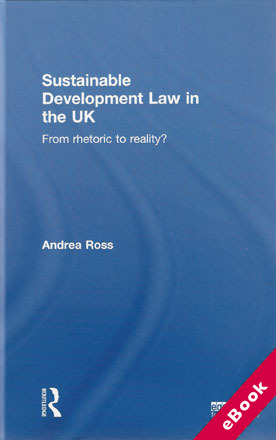
Sustainable development is now widely accepted as a political objective in the UK and elsewhere but to what extent has the UK's rhetoric on sustainable development become a reality? The aim of this book is to critically examine the UK's approach to promoting and delivering sustainable development.
It begins by providing a detailed account of UK law on sustainable development by reviewing the various policy, institutional and legal mechanisms used by the UK since the 1980s and by devolved administrations since devolution took effect in 1999. Progress has been slow, too slow and, according to the scientists, time is running out. To deal with this lack of progress, the book advocates increasing the status of ecological sustainability and sustainable development through the introduction of a wide range of legal mechanisms which would compel the change needed.
The book calls for ecological sustainability, or respecting the Earth's environmental limits, to be afforded the status of legal principle and argues that with ecological sustainability at its normative core, sustainable development could provide an effective framework for decision making and governance. It argues that to support this approach and ensure consistency, the time has come for sustainable development to receive explicit legal backing. Over and above its symbolic and educational value, legislation can impose mandatory rules on policymakers and decision makers, often with meaningful consequences both inside and outside the courtroom.
To this end, the book contributes to the theory on sustainable development governance by suggesting three possible legislative approaches for such intervention. The volume concludes that while a lack of leadership on sustainable development may hinder the introduction of these innovations, once introduced, these innovations would equally provide much needed support for effective leadership towards a sustainable future.










