
The eBooks we sell are sold as a single-user licence and are intended for the end user only.
The sale of some eBooks are restricted to certain countries. To alert you to such restrictions, please select the country of the billing address of your credit or debit card you wish to use for payment.
For further information see https://www.wildy.com/ebook-formats
Once the order is confirmed an e-mail will be sent to you to allow you to download the eBook. For UK purchases this will be automatic. For purchases outside the UK a member of staff will need to confirm the sale. (Staff are available to do this during normal business hours, Mon-Fri 8:30-17:00 UK time)
All eBooks are supplied firm sale and cannot be returned. If you believe there is a fault with your eBook then contact us on ebooks@wildy.com and we will help in resolving the issue. This does not affect your statutory rights.
The 1980s was a time of significant social, political and cultural change. In Australia, the law was pivotal to these changes.
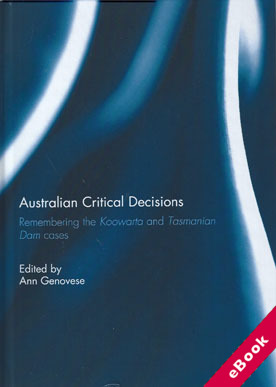
The two High Court cases that this book explores - Koowarta v Bjelke-Petersen (1982) and the Tasmanian Dams case (1983) - are famous legally as they marked a decisive reckoning by the Court with both international law and federal constitutionalism.
Yet these cases also offer a significant marker of Australia in the 1980s: a shift to a different form of political engagement, nationally and internationally, on complex questions about race and the environment.
This book brings these cases together for the first time. It does so to explore not only the legal legacy and relationship between Koowarta and Tasmanian Dams, but also to reflect on how Australians experience their law in time and place, and why those experiences might require more than the usual legal records. The authors include significant figures in Australian public life, some of whom were key participants in the cases, as well as established and respected scholars of law, history, environment and Indigenous studies.
This collection offers a combination of personal recollections of the cases, as well as a consideration of their ongoing significance in Australian life. This book was originally published as two special issues of the Griffith Law Review.










