
The eBooks we sell are sold as a single-user licence and are intended for the end user only.
The sale of some eBooks are restricted to certain countries. To alert you to such restrictions, please select the country of the billing address of your credit or debit card you wish to use for payment.
For further information see https://www.wildy.com/ebook-formats
Once the order is confirmed an e-mail will be sent to you to allow you to download the eBook. For UK purchases this will be automatic. For purchases outside the UK a member of staff will need to confirm the sale. (Staff are available to do this during normal business hours, Mon-Fri 8:30-17:00 UK time)
All eBooks are supplied firm sale and cannot be returned. If you believe there is a fault with your eBook then contact us on ebooks@wildy.com and we will help in resolving the issue. This does not affect your statutory rights.
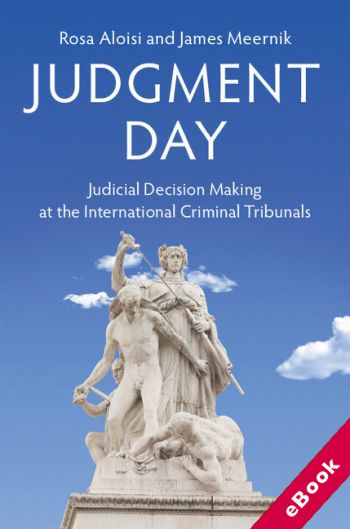
This book demonstrates how, after many years of inactivity after the World War II tribunals, judges at the Yugoslav, Rwanda and Sierra Leone tribunals, and to a lesser extent the International Criminal Court, have seized the opportunity to develop international law on war crimes, crimes against humanity and genocide.
Meernik and Aloisi argue that judges are motivated by a concern for human rights protection and the legacy of international criminal justice. They have progressively expanded the reach of international law to protect human rights and have used the power of their own words to condemn human rights atrocities. Judges have sentenced the guilty to lengthy and predictable terms in prison to provide justice, deterrence of future violations and even to advance peace and reconciliation. On judgment day, we show that judges have sought to enhance the power of international justice.










