
The eBooks we sell are sold as a single-user licence and are intended for the end user only.
The sale of some eBooks are restricted to certain countries. To alert you to such restrictions, please select the country of the billing address of your credit or debit card you wish to use for payment.
For further information see https://www.wildy.com/ebook-formats
Once the order is confirmed an e-mail will be sent to you to allow you to download the eBook. For UK purchases this will be automatic. For purchases outside the UK a member of staff will need to confirm the sale. (Staff are available to do this during normal business hours, Mon-Fri 8:30-17:00 UK time)
All eBooks are supplied firm sale and cannot be returned. If you believe there is a fault with your eBook then contact us on ebooks@wildy.com and we will help in resolving the issue. This does not affect your statutory rights.
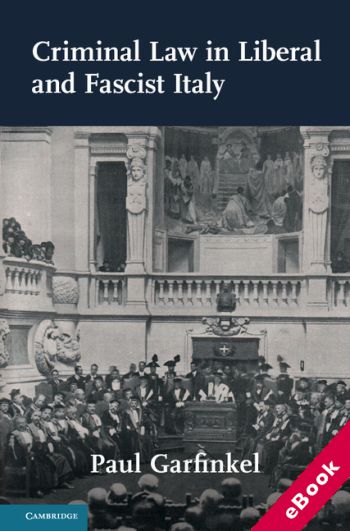
By extending the chronological parameters of existing scholarship, and by focusing on legal experts' overriding and enduring concern with 'dangerous' forms of common crime, this study offers a major reinterpretation of criminal-law reform and legal culture in Italy from the Liberal (1861-1922) to the Fascist era (1922-43).
Garfinkel argues that scholars have long overstated the influence of positivist criminology on Italian legal culture and that the kingdom's penal-reform movement was driven not by the radical criminological theories of Cesare Lombroso, but instead by a growing body of statistics and legal researches that related rising rates of crime to the instability of the Italian state. Drawing on a vast array of archival, legal and official sources, the author explains the sustained and wide-ranging interest in penal-law reform that defined this era in Italian legal history while analyzing the philosophical underpinnings of that reform and its relationship to contemporary penal-reform movements abroad.










