
The eBooks we sell are sold as a single-user licence and are intended for the end user only.
The sale of some eBooks are restricted to certain countries. To alert you to such restrictions, please select the country of the billing address of your credit or debit card you wish to use for payment.
For further information see https://www.wildy.com/ebook-formats
Once the order is confirmed an e-mail will be sent to you to allow you to download the eBook. For UK purchases this will be automatic. For purchases outside the UK a member of staff will need to confirm the sale. (Staff are available to do this during normal business hours, Mon-Fri 8:30-17:00 UK time)
All eBooks are supplied firm sale and cannot be returned. If you believe there is a fault with your eBook then contact us on ebooks@wildy.com and we will help in resolving the issue. This does not affect your statutory rights.
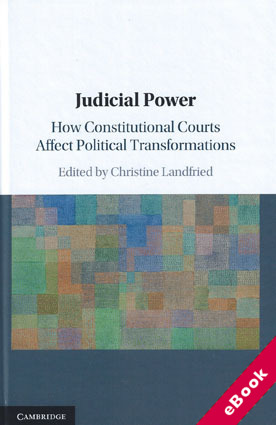
The power of national and transnational constitutional courts to have the final say in interpreting the constitution or an international treaty has been endlessly discussed. What does it mean for democratic governance that non-elected judges influence politics and policies?
The authors of Judicial Power - legal scholars, political scientists, and judges - take a fresh look at this problem. To date, research has concentrated on the legitimacy, or the effectiveness, or specific decision-making methods of constitutional courts. By contrast, the authors here explore the relationship among these three factors.
This book presents the hypothesis that judicial review allows for a method of reflecting on social integration that differs from political methods, and, precisely because of the difference between judicial and political decision-making, strengthens democratic governance.
This hypothesis is tested in case studies on the role of constitutional courts in political transformations, on the methods of these courts, and on transnational judicial interactions.











