
The eBooks we sell are sold as a single-user licence and are intended for the end user only.
The sale of some eBooks are restricted to certain countries. To alert you to such restrictions, please select the country of the billing address of your credit or debit card you wish to use for payment.
For further information see https://www.wildy.com/ebook-formats
Once the order is confirmed an e-mail will be sent to you to allow you to download the eBook. For UK purchases this will be automatic. For purchases outside the UK a member of staff will need to confirm the sale. (Staff are available to do this during normal business hours, Mon-Fri 8:30-17:00 UK time)
All eBooks are supplied firm sale and cannot be returned. If you believe there is a fault with your eBook then contact us on ebooks@wildy.com and we will help in resolving the issue. This does not affect your statutory rights.
Due to a technical issue some ebooks are not available to order.
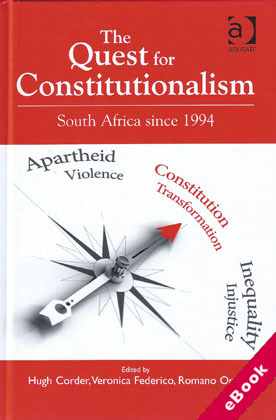
This volume provides a timely assessment on the progress made towards the achievement of a constitutional democracy in South Africa. The chapters collectively present an in-depth analysis of the development of the legal system and of the implications of the Constitution for the social configuration of power. To what extent has the vision of constitutionalism contained in the Constitution been realised?
Primarily concerned with the impact of laws and the salience of their existence and enforcement for South Africans, the work highlights the importance of placing the constitutional regime in its historical, cultural, social, economic and political context.
The book further recognizes the importance of the South African constitutional provisions for transnational or globalised constitutionalism more broadly. It contains contributions from South African scholars, as well as European authors, bringing in new analytical angles and adding a specific comparative dimension.
Through the prism of South Africa, the authors discuss the innovative character of constitutional and legal provisions in terms of both constitution-making and law-making processes and their contents.
This book provides analysis that will be relevant to scholars, students and practitioners, specifically those interested in International Relations, Law, Sociology of Law, and African Studies, as well as socio-political comparative studies.










