
The eBooks we sell are sold as a single-user licence and are intended for the end user only.
The sale of some eBooks are restricted to certain countries. To alert you to such restrictions, please select the country of the billing address of your credit or debit card you wish to use for payment.
For further information see https://www.wildy.com/ebook-formats
Once the order is confirmed an e-mail will be sent to you to allow you to download the eBook. For UK purchases this will be automatic. For purchases outside the UK a member of staff will need to confirm the sale. (Staff are available to do this during normal business hours, Mon-Fri 8:30-17:00 UK time)
All eBooks are supplied firm sale and cannot be returned. If you believe there is a fault with your eBook then contact us on ebooks@wildy.com and we will help in resolving the issue. This does not affect your statutory rights.
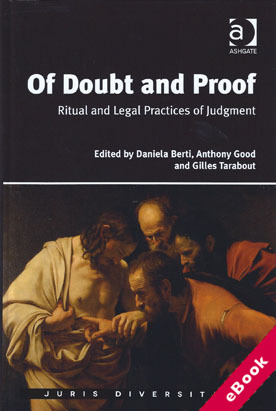
All institutions concerned with the process of judging - whether it be deciding between alternative courses of action, determining a judge's professional integrity, assigning culpability for an alleged crime, or ruling on the credibility of an asylum claimant - are necessarily directly concerned with the question of doubt.
Broadening the theoretical understandings of the social role of doubt, both in social science and in law, the authors present these understandings in ways that not only contribute to academic knowledge but are also useful to professionals and other participants engaged in the process of judging. This collection will consequently be of great interest to academics researching in the fields of legal anthropology, ritual studies, legal sociology, criminology, and socio-legal studies.










