
The eBooks we sell are sold as a single-user licence and are intended for the end user only.
The sale of some eBooks are restricted to certain countries. To alert you to such restrictions, please select the country of the billing address of your credit or debit card you wish to use for payment.
For further information see https://www.wildy.com/ebook-formats
Once the order is confirmed an e-mail will be sent to you to allow you to download the eBook. For UK purchases this will be automatic. For purchases outside the UK a member of staff will need to confirm the sale. (Staff are available to do this during normal business hours, Mon-Fri 8:30-17:00 UK time)
All eBooks are supplied firm sale and cannot be returned. If you believe there is a fault with your eBook then contact us on ebooks@wildy.com and we will help in resolving the issue. This does not affect your statutory rights.
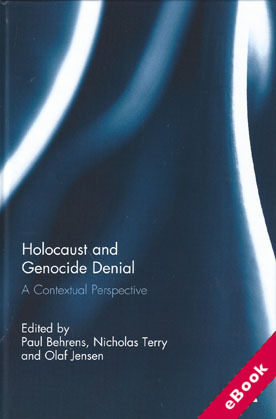
This book provides a detailed analysis of one of the most prominent and widespread international phenomena to which criminal justice systems has been applied: the expression of revisionist views relating to mass atrocities and the outright denial of their existence.
Denial poses challenges to more than one academic discipline: to historians, the gradual disappearance of the generation of eyewitnesses raises the question of how to keep alive the memory of the events, and the fact that negationism is often offered in the guise of historical 'revisionist scholarship' also means that there is need for the identification of parameters which can be applied to the office of the 'genuine' historian.
Legal academics and practitioners as well as political scientists are faced with the difficulty of evaluating methods to deal with denial and must in this regard identify the limits of freedom of speech, but also the need to preserve the rights of victims.
Beyond that, the question arises whether the law can ever be an effective option for dealing with revisionist statements and the revisionist movement. In this regard, Holocaust and Genocide Denial: A Contextual Perspective breaks new ground: exploring the background of revisionism, the specific methods devised by individual States to counter this phenomenon, and the rationale for their strategies.
Bringing together authors whose expertise relates to the history of the Holocaust, genocide studies, international criminal law and social anthropology, the book offers insights into the history of revisionism and its varying contexts, but also provides a thought-provoking engagement with the challenging questions attached to its treatment in law and politics.










