
The eBooks we sell are sold as a single-user licence and are intended for the end user only.
The sale of some eBooks are restricted to certain countries. To alert you to such restrictions, please select the country of the billing address of your credit or debit card you wish to use for payment.
For further information see https://www.wildy.com/ebook-formats
Once the order is confirmed an e-mail will be sent to you to allow you to download the eBook. For UK purchases this will be automatic. For purchases outside the UK a member of staff will need to confirm the sale. (Staff are available to do this during normal business hours, Mon-Fri 8:30-17:00 UK time)
All eBooks are supplied firm sale and cannot be returned. If you believe there is a fault with your eBook then contact us on ebooks@wildy.com and we will help in resolving the issue. This does not affect your statutory rights.
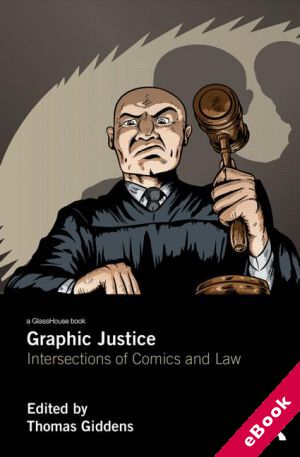
Establishing the medium of graphic fiction as a critical resource for interdisciplinary legal studies, this collection is the first to address the intersection of comics and law. Graphic fiction has gained enormous cultural capital and academic interest over recent years.
Comics-inspired films fill our cinemas and superhero merchandise fills the shelves of supermarkets. In short, our culture is suffused with a comic-book aesthetic: as, for example, the ‘Occupy’ movement appropriates the mask of ‘V’, from the comic work V for Vendetta; and, tragically, as James Holmes’s murderous rampage through a Colorado movie theatre, seemingly sees him styling himself after Batman’s arch-nemesis, the Joker.
From mass entertainment and consumerism to political activism and violence, we are surrounded by emanations of graphic storytelling. Meanwhile, the rise of academic disciplines such as comics studies demonstrates that the medium contains much more depth than the common assumption of its simplicity and juvenility might suggest.
Against this background, comics offer an important resource for making sense of the contemporary place and role of law. Whether in their representations of lawyers and the legal system, their dystopian imaginations, their treatment of issues of justice and social order, or in their superheroic investment in the protection of the innocent and the punishment or capture of those who would harm them, like other narrative forms – literature, film, theatre – graphic fiction explores and expresses human life in all its social, moral and legal complexity.
In the context of a now well established interest in cultural legal studies, this book showcases the critical potential of comics and graphic fiction as a resource for interdisciplinary legal studies and legal theory.










