
The eBooks we sell are sold as a single-user licence and are intended for the end user only.
The sale of some eBooks are restricted to certain countries. To alert you to such restrictions, please select the country of the billing address of your credit or debit card you wish to use for payment.
For further information see https://www.wildy.com/ebook-formats
Once the order is confirmed an e-mail will be sent to you to allow you to download the eBook. For UK purchases this will be automatic. For purchases outside the UK a member of staff will need to confirm the sale. (Staff are available to do this during normal business hours, Mon-Fri 8:30-17:00 UK time)
All eBooks are supplied firm sale and cannot be returned. If you believe there is a fault with your eBook then contact us on ebooks@wildy.com and we will help in resolving the issue. This does not affect your statutory rights.
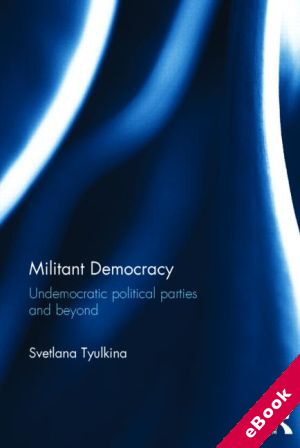
The term ‘militant democracy’ was coined by Karl Loewenstein in the 1930s. He argued that attempts to establish democracy in the Weimar Republic failed due to the lack of militancy against subversive movements. The concept of militant democracy was introduced to legal scholarship and constitutional practice so as to provide democracy with legal means to defend itself against the range of possible activities of non-democratic political actors.
This book offers a broad comparative look at the legal concept of militant democracy. It combines an analysis of major theoretical considerations of this concept with a substantive practical component investigating its practice in a number of countries and on a diverse array of issues. The historical development of militant democracy in constitutional theory is mapped and the book explores how militant democracy interacts with various traditional and contemporary notions of democracy. The possibilities and pitfalls of the concept of protecting democracy when it is under threat of harm or destruction by undemocratic actors are analysed, and the book suggests possible solutions and measures to overcome those dangers and concerns. The book provides a thematic treatment of militant democracy practices in a wide range of jurisdictions, including Australia, Turkey, Spain, Germany, Israel, India, the USA and the Council of Europe. The case-study elements include the most apparent examples of militant democracy practice that of the prohibition of political parties, as well as recent developments in the understanding of the concept and its interpretation such as the extension of militant democracy to address threats other than undemocratic political parties. The book considers how dangerous religious movements and the threat of terrorism could be addressed by applying the logic of militant democracy.











