
The eBooks we sell are sold as a single-user licence and are intended for the end user only.
The sale of some eBooks are restricted to certain countries. To alert you to such restrictions, please select the country of the billing address of your credit or debit card you wish to use for payment.
For further information see https://www.wildy.com/ebook-formats
Once the order is confirmed an e-mail will be sent to you to allow you to download the eBook. For UK purchases this will be automatic. For purchases outside the UK a member of staff will need to confirm the sale. (Staff are available to do this during normal business hours, Mon-Fri 8:30-17:00 UK time)
All eBooks are supplied firm sale and cannot be returned. If you believe there is a fault with your eBook then contact us on ebooks@wildy.com and we will help in resolving the issue. This does not affect your statutory rights.
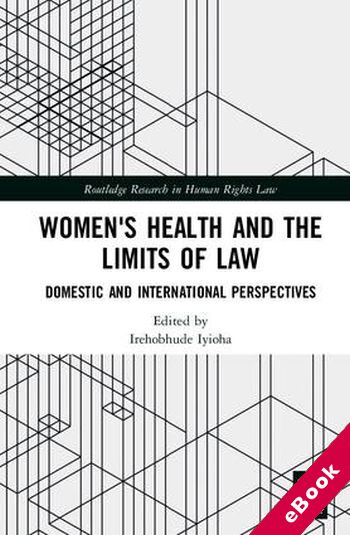
Despite some significant advances in the creation and protection of rights affecting women’s health, these do not always translate into actual health benefits for women. This collection asks: 'What is an effective law and what influences law’s effectiveness or ineffectiveness? What dynamics, elements, and conditions come together to limit law’s capacity to achieve instrumental goals for women’s health and the advancement of women’s health rights?'
The book presents an integrated, co-referential and sustained critical discussion of the normative and constitutive reasons for law’s limited effectiveness in the field of women’s health. It offers comprehensive and cohesive explanatory accounts of law’s limits and for the first time in the field, introduces a distinction between formal and substantive effectiveness of laws. Its approach is trans-systemic, multi-jurisdictional and comparative, with a focus on six countries in North America, Europe, Asia, and Africa and international human rights case law based on matters arising from Hungary, Portugal, Spain, Slovakia, Czech Republic, Peru and Bolivia.
The book will be a valuable resource for educators, students, lawyers, rights advocates, and policy-makers working in women’s health, socio-legal studies, human rights, feminist legal studies, and legal philosophy more broadly.










