
The eBooks we sell are sold as a single-user licence and are intended for the end user only.
The sale of some eBooks are restricted to certain countries. To alert you to such restrictions, please select the country of the billing address of your credit or debit card you wish to use for payment.
For further information see https://www.wildy.com/ebook-formats
Once the order is confirmed an e-mail will be sent to you to allow you to download the eBook. For UK purchases this will be automatic. For purchases outside the UK a member of staff will need to confirm the sale. (Staff are available to do this during normal business hours, Mon-Fri 8:30-17:00 UK time)
All eBooks are supplied firm sale and cannot be returned. If you believe there is a fault with your eBook then contact us on ebooks@wildy.com and we will help in resolving the issue. This does not affect your statutory rights.
Due to a technical issue some ebooks are not available to order.
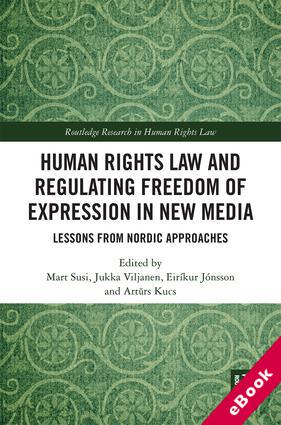
The Nordic countries are well known globally by their high human rights standards and at the same time a high degree of internet freedom. This edited collection reveals how the Nordic countries have succeeded in the task of protecting freedom of expression the new media. It contains an overview of public policy choices and best practices of domestic online companies, which can have the aspiration of finding global acceptance.
Reviewing the topic of freedom of expression in new media within Nordic and Baltic countries, this book incorporates both general themes and interesting country-specific themes that will provide wider knowledge on the development of freedom of expression and media law in the online media era. Comprehensive analysis of regulation of online media, both at the level of legislation and application of law in courts and other authorities, are included. This book will contribute to the on-going discussion as to whether there is a need to modify prevailing interpretation of freedom of expression.
Human Rights Law and Regulating Freedom of Expression in New Media focuses on the multi-layered and complicated relationship between internet and human rights law. It contributes to the ongoing discussion regarding the protection of freedom of expression in the internet in the context of various doctrines of constitutional law, including the proliferation of constitutional adjudication. It will be of interest to researchers, academics, policymakers, and students in the fields of human rights law, internet law, political science, sociology, cultural studies, media and communications studies, and technology.










