
The eBooks we sell are sold as a single-user licence and are intended for the end user only.
The sale of some eBooks are restricted to certain countries. To alert you to such restrictions, please select the country of the billing address of your credit or debit card you wish to use for payment.
For further information see https://www.wildy.com/ebook-formats
Once the order is confirmed an e-mail will be sent to you to allow you to download the eBook. For UK purchases this will be automatic. For purchases outside the UK a member of staff will need to confirm the sale. (Staff are available to do this during normal business hours, Mon-Fri 8:30-17:00 UK time)
All eBooks are supplied firm sale and cannot be returned. If you believe there is a fault with your eBook then contact us on ebooks@wildy.com and we will help in resolving the issue. This does not affect your statutory rights.
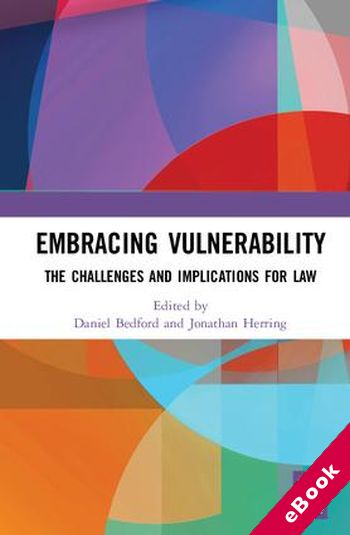
This book brings together legal scholars engaging with vulnerability theory to explore the implications and challenges for law of understanding vulnerability as generative, and a source of connection and development.
The book is structured into five sections that cover fields of law where there is already significant recourse to the concept of vulnerability. These sections include a main chapter by a legal theorist who has previously examined the creative potential of vulnerability and responses from scholars working in the same field. This is designed to draw out some of the central debates concerning how vulnerability is conceptualised in law.
Several contributors highlight the need to re-focus on some of these more positive aspects of vulnerability in order to counter the way law is being used to mask that condition in order to enable more people to escape the stigma associated with it. They seek to explore how law might embrace vulnerability, rather than conceal it. The book also includes contributions that seek to bring vulnerability into a non-binary relationship with other core legal concepts, such as autonomy and dignity. Rather than discarding these legal concepts in favour of vulnerability, these contributions highlight how vulnerability can be entwined with relational autonomy and embodied dignity.
This book is essential reading for both students studying legal theory and practitioners interested in vulnerability.











