
The eBooks we sell are sold as a single-user licence and are intended for the end user only.
The sale of some eBooks are restricted to certain countries. To alert you to such restrictions, please select the country of the billing address of your credit or debit card you wish to use for payment.
For further information see https://www.wildy.com/ebook-formats
Once the order is confirmed an e-mail will be sent to you to allow you to download the eBook. For UK purchases this will be automatic. For purchases outside the UK a member of staff will need to confirm the sale. (Staff are available to do this during normal business hours, Mon-Fri 8:30-17:00 UK time)
All eBooks are supplied firm sale and cannot be returned. If you believe there is a fault with your eBook then contact us on ebooks@wildy.com and we will help in resolving the issue. This does not affect your statutory rights.
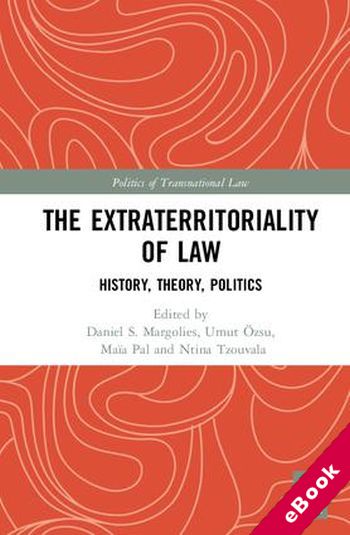
Questions of legal extraterritoriality figure prominently in scholarship on legal pluralism, transnational legal studies, international investment law, international human rights law, state responsibility under international law, and a large number of other areas. Yet many accounts of extraterritoriality make little effort to grapple with its thorny conceptual history, shifting theoretical valence, and complex political roots and ramifications.
This book brings together thirteen scholars of law, history, and politics in order to reconsider the history, theory, and contemporary relevance of legal extraterritoriality. Situating questions of extraterritoriality in a set of broader investigations into state-building, imperialist rivalry, capitalist expansion, and human rights protection, it tracks the multiple meanings and functions of a distinct and far-reaching mode of legal authority. The fundamental aim of the volume is to examine the different geographical contexts in which extraterritorial regimes have developed, the political and economic pressures in response to which such regimes have grown, the highly uneven distributions of extraterritorial privilege that have resulted from these processes, and the complex theoretical quandaries to which this type of privilege has given rise.
The book will be of considerable interest to scholars in law, history, political science, socio-legal studies, international relations, and legal geography.










