The eBooks we sell are sold as a single-user licence and are intended for the end user only.
The sale of some eBooks are restricted to certain countries. To alert you to such restrictions, please select the country of the billing address of your credit or debit card you wish to use for payment.
For further information see https://www.wildy.com/ebook-formats
Once the order is confirmed an e-mail will be sent to you to allow you to download the eBook. For UK purchases this will be automatic. For purchases outside the UK a member of staff will need to confirm the sale. (Staff are available to do this during normal business hours, Mon-Fri 8:30-17:00 UK time)
All eBooks are supplied firm sale and cannot be returned. If you believe there is a fault with your eBook then contact us on ebooks@wildy.com and we will help in resolving the issue. This does not affect your statutory rights.
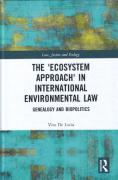
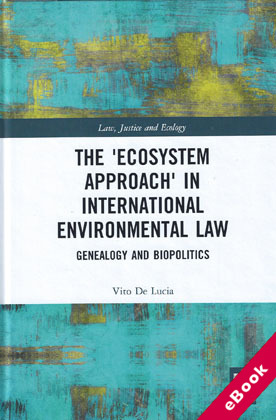
The ecosystem approach, broadly understood as a legal and governance strategy for integrated environmental and biodiversity management, has been adopted within a wide variety of international environmental legal regimes and provides a narrative, a policy approach and in some cases legally binding obligations for States to implement what has been called a ‘new paradigm’ of environmental management.
In this last respect, the ecosystem approach is also often considered to offer an opportunity to move beyond the outdated anthropocentric framework underpinning much of international environmental law, thus helping re-think law in the Anthropocene.
Against this background, this book addresses the question of whether the ecosystem approach represents a paradigm shift in international environmental law and governance, or whether it is in conceptual and operative continuity with legal modernity. This central question is explored through a combined genealogical and biopolitical framework, which reveals how the ecosystem approach is the result of multiple contingencies and contestations, and of the interplay of divergent and sometimes irreconcilable ideological projects.
The ecosystem approach, this books shows, does not have a univocal identity, and must be understood as both signalling the potential for a decisive shift in the philosophical orientation of law and the operationalisation of a biopolitical framework of control that is in continuity with, and even intensifies, the eco-destructive tendencies of legal modernity.
It is, however, in revealing this disjunction that the book opens up the possibility of moving beyond the already tired assessment of environmental law through the binary of anthropocentrism and ecocentrism.