The eBooks we sell are sold as a single-user licence and are intended for the end user only.
The sale of some eBooks are restricted to certain countries. To alert you to such restrictions, please select the country of the billing address of your credit or debit card you wish to use for payment.
For further information see https://www.wildy.com/ebook-formats
Once the order is confirmed an e-mail will be sent to you to allow you to download the eBook. For UK purchases this will be automatic. For purchases outside the UK a member of staff will need to confirm the sale. (Staff are available to do this during normal business hours, Mon-Fri 8:30-17:00 UK time)
All eBooks are supplied firm sale and cannot be returned. If you believe there is a fault with your eBook then contact us on ebooks@wildy.com and we will help in resolving the issue. This does not affect your statutory rights.
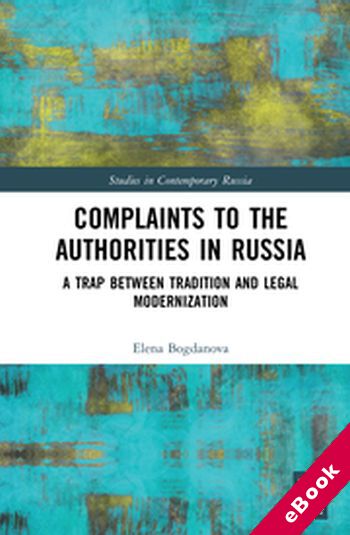
This book considers the process of legal modernization in Russia from the perspective of the development of the mechanism of complaints addressed to the authorities from the pre-revolutionary period to today. It analyses wide-ranging data and sources, collected over 17 years, such as legislation, in-depth interviews, archival materials, original texts, and examples of different methods of complaints in the Soviet and contemporary Russia.
Being marginal to the legal system and almost invisible for researchers of legal development, the complaint mechanism has functioned as an extremely important way of restoring justice, available to the majority of people in Russia through centuries. It has survived several historical gaps and, in a sense, acts as a thread that stitches different eras, coexisting with the establishment and modernization of legal institutions, compensating, accompanying, and sometimes substituting for them. The research covers a period of over 100 years, and shows, how and why at major historical crossroads, Russia chooses between full-fledged legal modernization and saving of the authoritarian social contract between the state and society.
This book will be especially useful to scholars researching Soviet society and Post-Soviet transformations, socio-legal studies, and liberal legal reforms, but will also appeal to those working in the broader fields of Russian Politics, the history of Soviet society and justice issues more generally.