The eBooks we sell are sold as a single-user licence and are intended for the end user only.
The sale of some eBooks are restricted to certain countries. To alert you to such restrictions, please select the country of the billing address of your credit or debit card you wish to use for payment.
For further information see https://www.wildy.com/ebook-formats
Once the order is confirmed an e-mail will be sent to you to allow you to download the eBook. For UK purchases this will be automatic. For purchases outside the UK a member of staff will need to confirm the sale. (Staff are available to do this during normal business hours, Mon-Fri 8:30-17:00 UK time)
All eBooks are supplied firm sale and cannot be returned. If you believe there is a fault with your eBook then contact us on ebooks@wildy.com and we will help in resolving the issue. This does not affect your statutory rights.
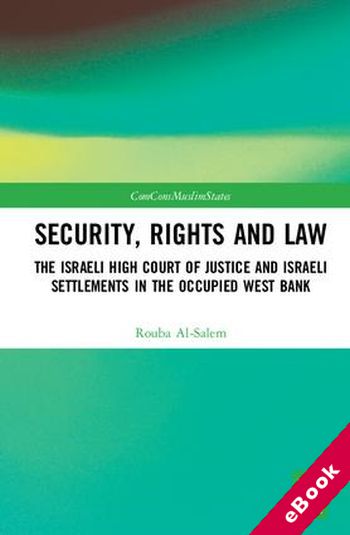
This book examines how the Israeli High Court of Justice has interpreted and applied international law principles in adjudicating petitions filed by Palestinians. The research focuses on HCJ judgments that have been rendered since the outbreak of the Second Intifada (2000) in relation to petitions challenging the legality of measures implemented by Israeli government and military authorities for the professed need of enhancing the security of Israeli settlements and settlers in the occupied West Bank. It discusses to what extent the HCJ provides a venue for an effective domestic remedy for alleged violations of the Palestinians’ internationally protected rights. It further analyses the judgements of the Court seeking to demonstrate why it appears to show a preference for invoking principles of Israeli administrative and constitutional law, thereby promoting the domestic rather than international Rule of Law. Although the jurisprudence of the HCJ has often been hailed as that of an ‘activist’ court, the analysis of petitions adjudicated by the Court between 2000 and 2014, illustrates why its approach is ill-suited to a situation of prolonged military occupation. Finally, the book evaluates what impact the Court’s adjudication, reasoning and interpretation has on the normative coherence of the international law of belligerent occupation.