
The eBooks we sell are sold as a single-user licence and are intended for the end user only.
The sale of some eBooks are restricted to certain countries. To alert you to such restrictions, please select the country of the billing address of your credit or debit card you wish to use for payment.
For further information see https://www.wildy.com/ebook-formats
Once the order is confirmed an e-mail will be sent to you to allow you to download the eBook. For UK purchases this will be automatic. For purchases outside the UK a member of staff will need to confirm the sale. (Staff are available to do this during normal business hours, Mon-Fri 8:30-17:00 UK time)
All eBooks are supplied firm sale and cannot be returned. If you believe there is a fault with your eBook then contact us on ebooks@wildy.com and we will help in resolving the issue. This does not affect your statutory rights.
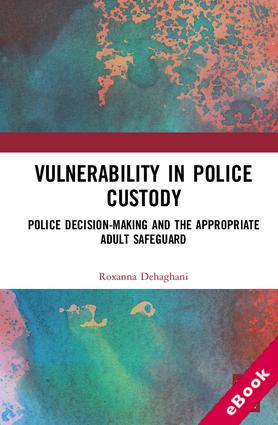
This book provides a nuanced and timely contribution to the question of vulnerability in police custody. It addresses the implementation of the appropriate adult safeguard in respect of adult suspects and explores police decision-making in this context. Drawing on empirical research carried out in England, the work takes a socio-legal approach to examine how and why police custody officers implement or not the appropriate adult safeguard.
The book’s core arguments are addressed within three parts. Part I examines how vulnerability is constructed philosophically and practically, firstly within the broader literature, thereafter at common law and in statute, and finally by police custody officers. Part 2 discusses how vulnerability is identified and how decisions are made in response to vulnerability. Part 3 critically assesses the theoretical understandings of police decision-making and criminal justice. Here it is argued that current theories on police decision-making hold explanatory power yet have significant shortcomings in relation to vulnerability and the appropriate adult safeguard.
The book thus presents new theoretical insights and, on the basis of these insights, asserts that the current regime of regulation must be reconsidered, while police compliance may only be ensured if vulnerability is radically reconceptualised.











