
The eBooks we sell are sold as a single-user licence and are intended for the end user only.
The sale of some eBooks are restricted to certain countries. To alert you to such restrictions, please select the country of the billing address of your credit or debit card you wish to use for payment.
For further information see https://www.wildy.com/ebook-formats
Once the order is confirmed an e-mail will be sent to you to allow you to download the eBook. For UK purchases this will be automatic. For purchases outside the UK a member of staff will need to confirm the sale. (Staff are available to do this during normal business hours, Mon-Fri 8:30-17:00 UK time)
All eBooks are supplied firm sale and cannot be returned. If you believe there is a fault with your eBook then contact us on ebooks@wildy.com and we will help in resolving the issue. This does not affect your statutory rights.
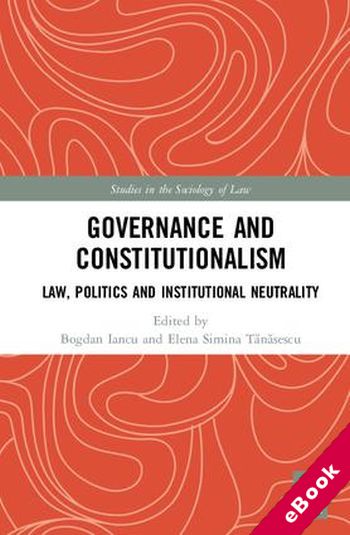
This collection studies the rise of neutral bodies as a challenge to the constitutional paradigm of the nation state. Administrative entities such as commissions, agencies, councils, authorities or ‘independent agencies’ as they are sometimes known, are relatively autonomous from majoritarian democratic control and by their institutional design fall outside the classical triad of powers or branches of government. They may even fall outside the confines of the nation state itself as with the EU Commission.
The book is divided into theoretical-historical and empirical parts. Part I approaches the phenomenon through the rigorous normative conceptual lens of constitutionalism and constitutional law, questioning the implications of political neutrality on inherited normative categories, both at national and supranational level. Part II comprises case-studies reflecting the full spectrum of theoretical frameworks and concerns developed and explored by the theory-oriented chapters in the first part. The work explores a wide range of issues including the balance between autonomy, legitimacy and accountability, the taxonomy of agencies, the role and limits of expertise as a paramount justification for independence, ‘agentification’ as a result of internationalisation, and ‘agentification’ as a reflex and consequence of transnational polity-building within the EU.










