
The eBooks we sell are sold as a single-user licence and are intended for the end user only.
The sale of some eBooks are restricted to certain countries. To alert you to such restrictions, please select the country of the billing address of your credit or debit card you wish to use for payment.
For further information see https://www.wildy.com/ebook-formats
Once the order is confirmed an e-mail will be sent to you to allow you to download the eBook. For UK purchases this will be automatic. For purchases outside the UK a member of staff will need to confirm the sale. (Staff are available to do this during normal business hours, Mon-Fri 8:30-17:00 UK time)
All eBooks are supplied firm sale and cannot be returned. If you believe there is a fault with your eBook then contact us on ebooks@wildy.com and we will help in resolving the issue. This does not affect your statutory rights.
Over the past two decades, the banking industry has expanded and consolidated at a stunningly unprecedented speed.
In this time banks have also moved from focusing purely on commercial banking activities to being heavily involved in market-based and transaction-oriented wholesale and investment banking activities. By carrying out an all-encompassing set of activities, banks have become large, complex, interconnected, and inclined to levels of risk taking not previously seen.
With the onset of 2008 global financial crisis it became apparent that there was an issue of institutions being too-big-to-fail.
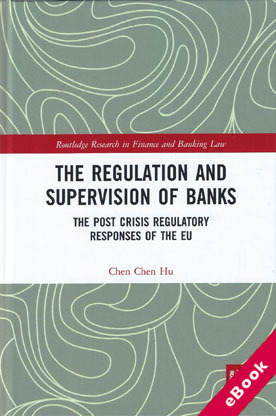
This book analyses the too-big-to-fail problem of banks in the EU. It approaches the topic from an interdisciplinary perspective using behavioural finance as a tool to examine the occurrence of the global financial crisis and the emergence of the structural problem in large banking institutions.
The book draws a comparison between the EU, the US and the UK and the relevant rules to assess the effectiveness of various approaches to regulation in a global context. Chen Chen Hu goes on to use behavioural analyses to provide new insights in evaluating the current structural reform rules in the EU Proposal on Bank Structural Regulation and the newly adopted bank recovery and resolution regime in the EU Bank Recovery and Resolution Directive and the Single Resolution Mechanism in the Single Resolution Regulation.











